1. Introduction: Demystifying the 3-Phase Solar Green Meter
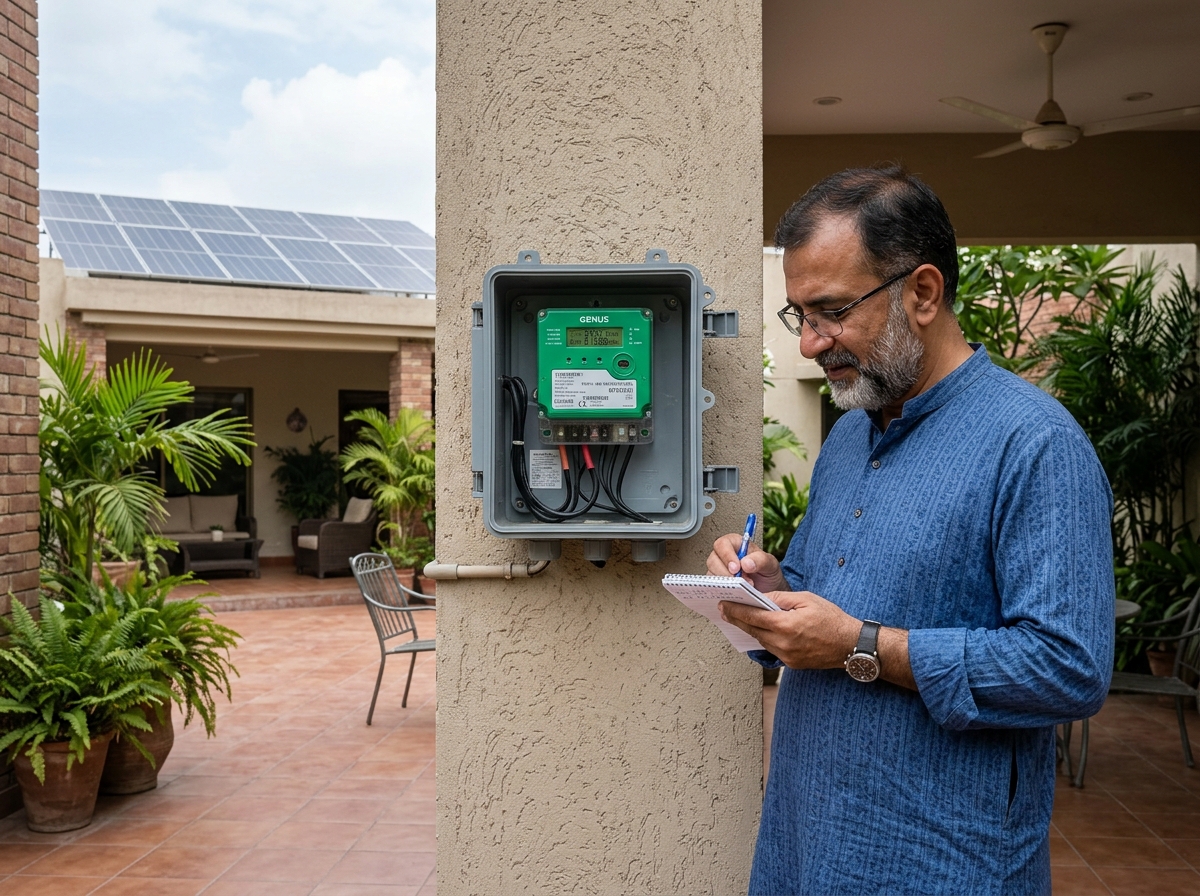
Following the successful installation of a grid-tied or hybrid solar photovoltaic system and the execution of a formal Net-Metering Agreement with a regional power distribution company (DISCO)—such as MEPCO, LESCO, IESCO, FESCO, GEPCO, PESCO, or K-Electric—the conventional unidirectional energy meter is decommissioned. In its place, the DISCO installs a specialized three-phase, four-wire static bi-directional energy meter, popularly referred to across Pakistan as the Green Meter.
For most Pakistani consumers, glancing at the scrolling digital liquid crystal display (LCD) of a green meter can be thoroughly confusing. The screen cycles through dozens of cryptic numeric codes, flashing symbols, arrow indicators, and voltage metrics. Unscrupulous meter readers or automated optical character recognition (OCR) billing apps occasionally record the incorrect register number—such as mistaking reactive export for active export, or recording peak import as off-peak import. Consequently, homeowners are frequently hit with inflated electricity bills, uncredited solar surplus units, or unwarranted detection charges. In this technical manual, BillsOnlinePk provides a line-by-line decoding of every major bi-directional meter deployed in Pakistan, empowering consumers to audit their solar export credits with complete mathematical precision.
Vital Consumer Advisory: Always take a clear photograph of your green meter’s LCD screen on the 1st of every calendar month at 10:00 AM, capturing both Code 01 (Active Import) and Code 02 (Active Export). Keep these photos stored with timestamps to dispute any discrepancy when your DISCO meter reader visits your premises.
2. Working Principle & Internal Architecture of Bi-Directional Static Energy Meters
A standard unidirectional digital meter contains current transformers (CTs) and voltage sensing dividers that compute instantaneous power ($P = V imes I imes cos heta$). Regardless of whether current flows into the premises from the WAPDA feeder or back into the grid from a domestic rooftop inverter, a unidirectional meter treats all current magnitude as positive load, charging the consumer for electricity they actually donated to the utility grid!
In contrast, a bi-directional static energy meter features high-precision multi-quadrant analog-to-digital converters (ADCs) and a dedicated digital signal processor (DSP). By monitoring the phase angle ($ heta$) between the AC voltage sine wave and the AC current waveform across all three phases (Red, Yellow, Blue):
- Quadrant I & IV (Forward Power Flow): When current lags or leads voltage in the forward direction, power is drawn from the utility grid into the house. The DSP registers this energy in the Active Import Register (kWh Import).
- Quadrant II & III (Reverse Power Flow): When rooftop solar generation exceeds instantaneous domestic appliance consumption, excess electrical energy flows through the main distribution board, exits the service drop cables, and enters the 11kV distribution transformer. The phase angle inverts by 180 degrees. The DSP recognizes this as reverse power flow and registers the energy in the Active Export Register (kWh Export).
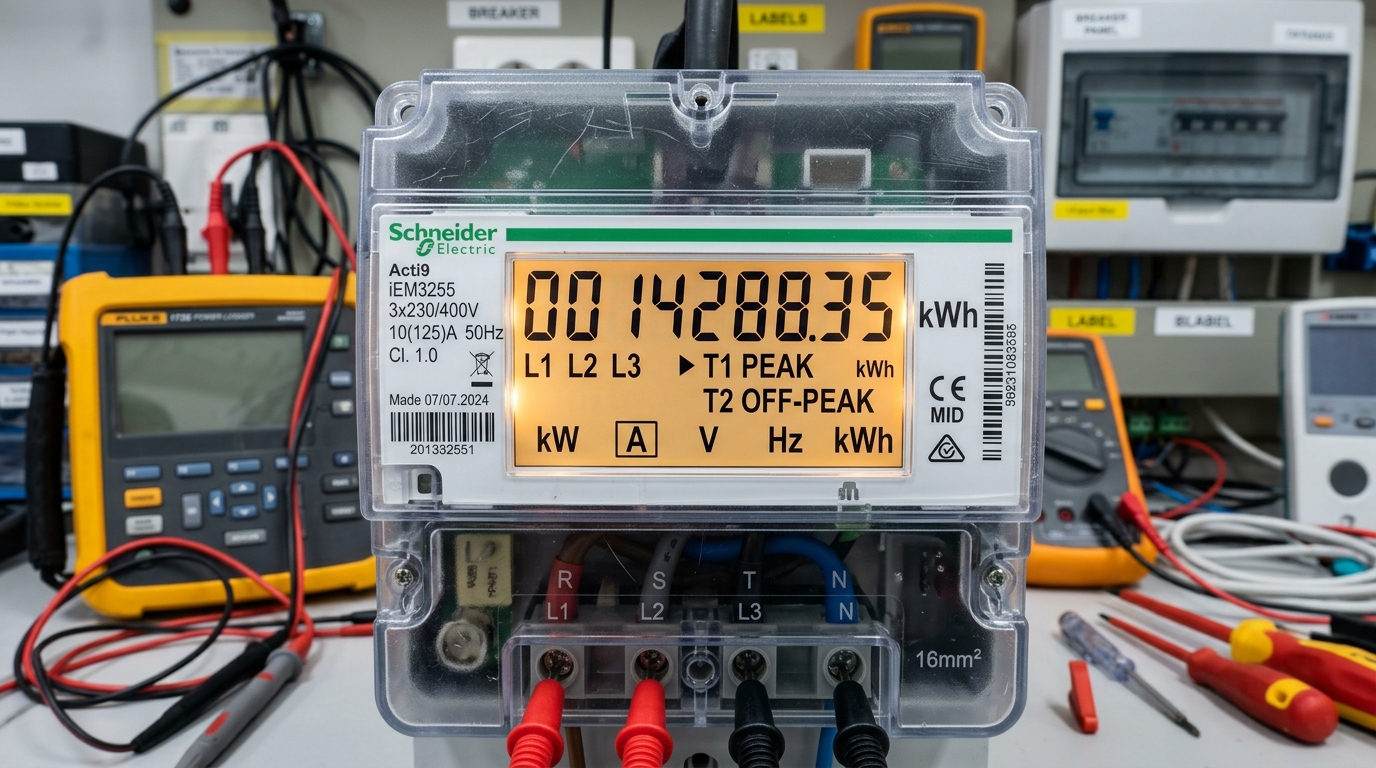
In Pakistan, DISCOs procure green meters compliant with IEC 62053-21 and NEPRA standard specifications from certified domestic and international meter manufacturers, including MicroTech Industries (MTI), Secure Meters, Sanxing Electric, Kaifa, Hexing Electrical, and Accurate Power. While physical housing shapes vary slightly, their internal register firmware conforms to standardized display parameter sequencing.
3. Comprehensive LCD Parameter Code Decoder (01 to 28)
When you stand in front of your green meter, the screen automatically auto-scrolls through individual display parameters, pausing for 5 to 7 seconds on each screen. Alternatively, pressing the manual push-button (optical navigation button) cycles through the sequence instantly. The table below outlines the universal display code mapping used by MEPCO, LESCO, IESCO, and K-Electric:
| Display Parameter Code | OBIS / Screen Indicator | Technical Description | Unit of Measurement | Relevance to Your Monthly Bill |
|---|---|---|---|---|
| Code 01 | 1.8.0 / C1 | Total Cumulative Active Import (All-Time) | kWh | Crucial: Total electricity units consumed from WAPDA grid since meter installation. |
| Code 02 | 2.8.0 / C2 | Total Cumulative Active Export (All-Time) | kWh | Crucial: Total solar units exported back to WAPDA grid since meter installation. |
| Code 03 | 1.8.1 / C3 | Peak Hours Active Import | kWh | Units drawn from grid during high-tariff evening peak hours (5 PM to 11 PM). |
| Code 04 | 1.8.2 / C4 | Off-Peak Hours Active Import | kWh | Units drawn from grid during normal daytime and late-night off-peak hours. |
| Code 07 | 2.8.1 / C7 | Peak Hours Active Export | kWh | Solar units exported during peak hours (rarely occurs unless system has commercial battery). |
| Code 08 | 2.8.2 / C8 | Off-Peak Hours Active Export | kWh | Crucial: All standard daytime solar surplus units sent to grid. |
| Code 14 | 1.6.0 / C14 | Maximum Demand Indicator (MDI) Import | kW | Highest 30-minute peak electrical load drawn from grid during current billing cycle. |
| Code 15 | 2.6.0 / C15 | Maximum Demand Indicator (MDI) Export | kW | Highest peak instantaneous power injected by solar inverter into grid. |
| Code 18 | 5.8.0 | Reactive Energy Import | kVARh | Inductive reactive load drawn by motors, compressors, and air conditioners. |
| Code 28 | 6.8.0 | Reactive Energy Export | kVARh | Capacitive reactive power injected into grid. |
4. Active Import (kWh) vs Active Export (kWh): How Units Flow
To audit your electricity bill, you only need to master two primary numbers: Code 01 (Active Import) and Code 02 (Active Export). Let us examine how these two registers operate during a normal 24-hour cycle in a Pakistani home equipped with a 10 kW rooftop solar system:
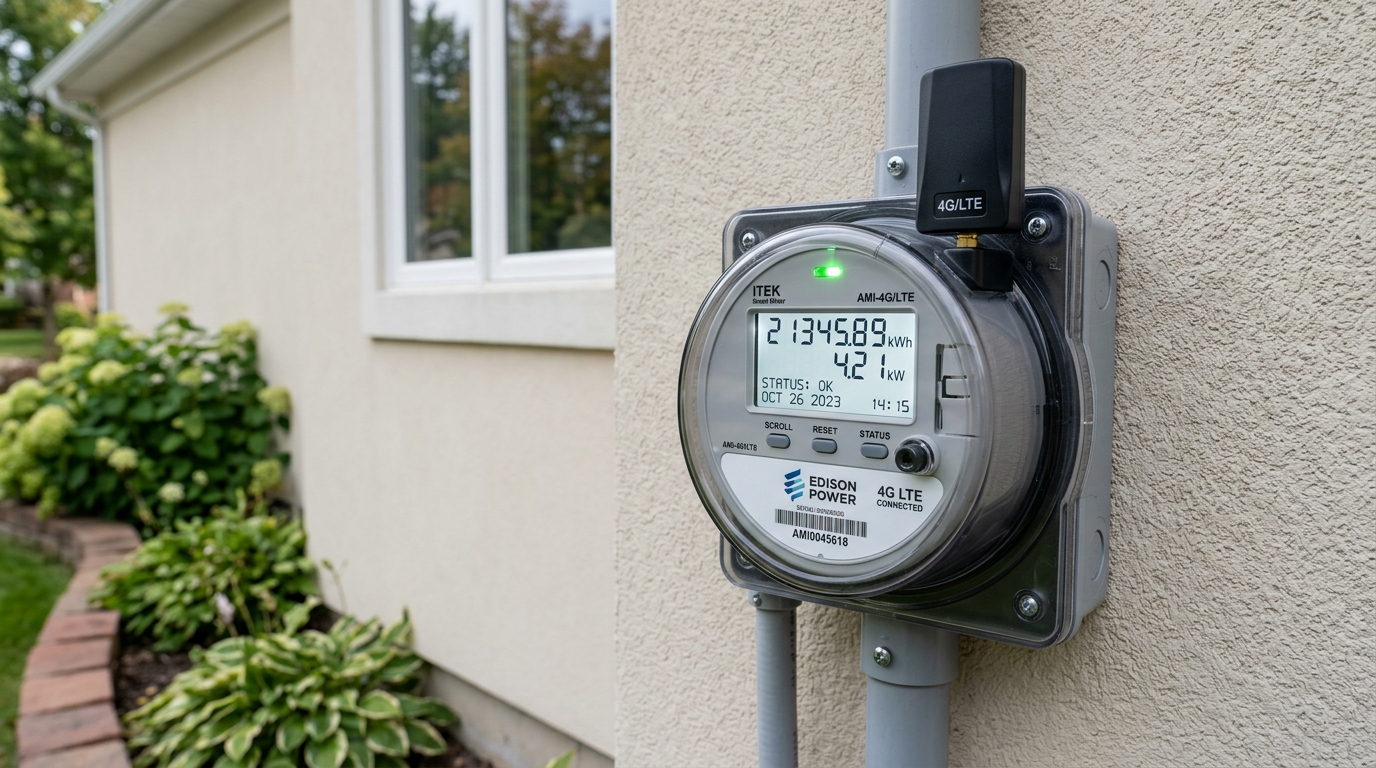
- Daytime Solar Generation (8:00 AM – 4:30 PM): The solar panels generate 7 kW of power. The household is running two inverter air conditioners and a refrigerator totaling 3 kW. The remaining 4 kW of surplus power flows backward through the green meter. Code 01 remains frozen, while Code 02 rapidly ticks upward. By 4:30 PM, the homeowner has exported 28 units (kWh).
- Evening Peak & Night Hours (5:00 PM – 7:00 AM): The sun sets, and solar generation ceases. The household turns on fans, lighting, TVs, and bedroom ACs totaling 4 kW. Power is now drawn exclusively from the WAPDA grid. Code 02 freezes completely, while Code 01 begins advancing. By next morning, the household has imported 22 units (kWh).
- Net Daily Energy Balance: Total Export = 28 units. Total Import = 22 units. Net Balance = +6 units in favor of the consumer! These 6 surplus units are banked in the DISCO’s billing computer as a credit against future consumption or cash rollover.
5. Peak vs Off-Peak Solar Accounting Rules under NEPRA Regulations
One of the most contentious aspects of solar net-metering in Pakistan centers on the regulatory treatment of Peak Hours versus Off-Peak Hours. Under NEPRA Net-Metering Regulations 2015 (and subsequent amendments through 2026), three-phase domestic (Tariff A-1) and commercial (Tariff A-2) connections are classified as Time-of-Use (TOU) accounts.
The peak hour window shifts seasonally across Pakistan:
- December to February: 5:00 PM to 9:00 PM
- March to May: 6:00 PM to 10:00 PM
- June to August: 7:00 PM to 11:00 PM
- September to November: 6:00 PM to 10:00 PM
Because solar panels stop generating electricity before peak hours commence, nearly 100 percent of your solar export occurs during Off-Peak Hours (Code 08). However, your air conditioners and household appliances consume power during the expensive Peak Hours (Code 03). Under NEPRA regulations, DISCOs do not permit direct 1:1 unit netting between peak units and off-peak units! Instead, net billing is executed through Financial Equivalent Offsetting:
Financial Net Value = (Surplus Off-Peak kWh × Off-Peak Buyback Rate) - (Peak kWh × Peak Grid Tariff)
If your surplus off-peak units have a financial value exceeding your peak consumption cost, your total net payable bill is reduced to zero, and the remaining monetary credit is carried forward to your next monthly bill.
6. Mathematical Formula: Reconciling Your Meter Readings with Monthly DISCO Bill
To verify that your monthly bill is 100 percent accurate, use the following standard reconciliation formula. Let us walk through an authentic real-world case study for a consumer under MEPCO Multan jurisdiction:
| Meter Reading Step | Current Month Reading | Previous Month Reading | Net Units (kWh) | Tariff Rate (PKR / Unit) | Total Financial Value |
|---|---|---|---|---|---|
| Off-Peak Import (Code 04) | 14,850 | 14,150 | 700 Units Import | PKR 48.50 | PKR 33,950 (Debit) |
| Off-Peak Export (Code 08) | 12,600 | 11,400 | 1,200 Units Export | PKR 27.50 (NEPRA Buyback) | PKR 33,000 (Credit) |
| Net Off-Peak Balance | - | - | 500 Units Surplus! | - | Banked in Account |
| Peak Import (Code 03) | 3,220 | 3,020 | 200 Units Import | PKR 64.80 | PKR 12,960 (Debit) |
| Peak Export (Code 07) | 0 | 0 | 0 Units | PKR 27.50 | PKR 0 |
| Fixed Charges & Meter Rent | - | - | - | - | PKR 1,250 |
| Government Taxes (GST, TV Fee) | - | - | - | - | PKR 2,480 |
| Net Payable / (Credit) | - | - | - | - | PKR 16,690 Payable |
In this scenario, because the consumer had a 500-unit net surplus in the off-peak register, those 500 units remain banked on the bill line labeled "Cumulative Energy Credit (kWh)". At the end of the quarterly financial settlement cycle (every three months), the DISCO converts banked units into cash credit, wiping out peak charges and taxes!
7. Troubleshooting Green Meter Fault Indicators: Err, Rev, Bat & Earth Tampering
Bi-directional meters are equipped with self-diagnostic micro-controllers that flash specific alarm flags when abnormal grid conditions, phase mismatches, or internal hardware faults occur:
- "REV" or Reverse Arrow Flashing: On a standard unidirectional meter, "REV" indicates electricity theft or reverse wiring. However, on a green meter, "REV" is completely normal during daylight hours! It signifies that your solar inverter is actively injecting surplus power back into the utility grid. If "REV" flashes at 11:00 PM when the sun is down, it indicates an improper neutral-earth loop or back-feeding from an unisolated UPS circuit.
- "EARTH" Indicator Lit: Indicates that current flowing through the phase wires does not match current returning through the neutral wire (current imbalance exceeding 30mA). This is typically caused by a neutral loop shared with a neighboring house, an ungrounded sub-distribution panel, or moisture in outdoor wiring conduits.
- "BAT" or Battery Symbol: The internal 3.6V lithium coin-cell battery powering the meter’s real-time clock (RTC) during load shedding has depleted below 2.8V. When the RTC fails, the meter cannot distinguish between Peak Hours and Off-Peak Hours, causing all units to be billed at the expensive peak rate! Report this immediately to your DISCO SDO for battery or meter replacement.
- "ERR-01" to "ERR-05": Signifies memory corruption in the non-volatile EEPROM chip or optical tamper detection triggered by opening the terminal cover. The meter must be recalibrated or replaced by the DISCO Meter Testing & Inspection (M&T) laboratory.
8. How to Challenge DISCO Meter Misreadings & Billing Errors at SDO Office
If your monthly electricity bill displays incorrect green meter readings, follow this legally recognized step-by-step contestation procedure:
- Freeze the Evidence: Immediately take date-stamped, high-resolution photographs or video footage of the meter cycling through Code 01, Code 02, Code 03, Code 04, Code 07, Code 08, and the meter's serial number.
- Compare with the Printed Bill: Check the "Present Reading" column on your printed bill. If the printed import reading is higher than your meter's physical screen, or if the exported units are lower than your physical Code 02 reading, you have undeniable proof of meter reader negligence.
- File Form-1 at SDO Office: Visit your local DISCO Sub-Divisional Officer (SDO) customer services center. Submit a written application titled "Request for Correction of Inadvertent Bi-Directional Net-Metering Reading Discrepancy" along with your photos and a copy of your paid previous bill.
- Demand a Revised Bill (P-Slip): The Commercial Revenue Officer (RO) is legally empowered under the NEPRA Consumer Service Manual (CSM) Chapter 6 to issue an amended bill (P-Slip) with corrected due dates and waived late fees within 24 hours.
- Escalate to NEPRA Consumer Affairs Division (CAD): If the SDO refuses to correct the billing within 7 days, file an online formal complaint at the NEPRA Complaint Portal (complaints.nepra.org.pk). NEPRA regularly imposes hefty compliance fines on DISCOs for net-metering overbilling.