Green Meter Demand Notice & Net Metering Costs 2026: MEPCO, LESCO, IESCO 3-Phase Bi-Directional Meter Application & Approval Timeline
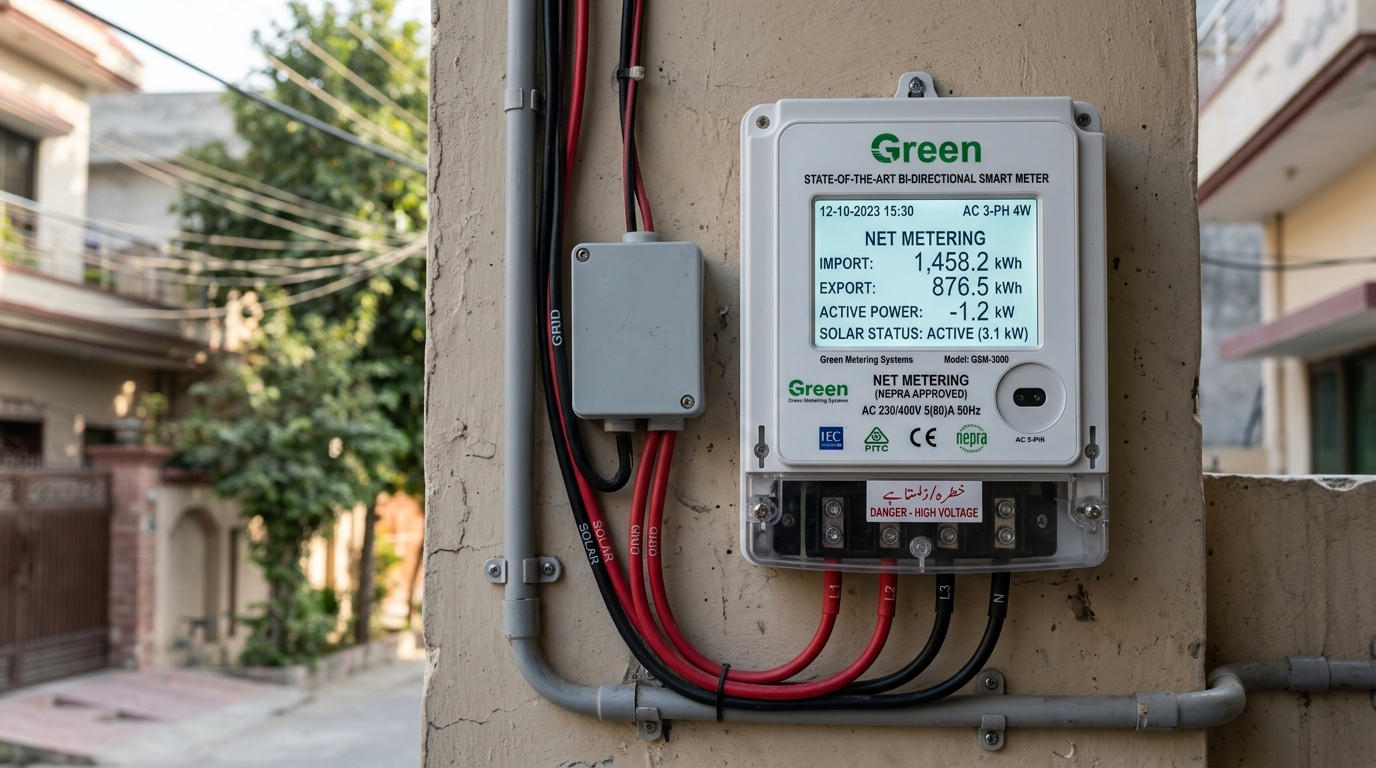
Executive Summary: Transitioning to rooftop solar without net metering leaves hundreds of thousands of rupees in export credits on the table. Under NEPRA Net Metering Regulations, consumers with an on-grid or hybrid solar system can export excess daytime power back to the national grid, spinning their electricity meters backwards. However, the most confusing hurdle for homeowners is securing the statutory 3-Phase Bi-Directional "Green Meter", paying the official Demand Notice, passing the distribution transformer capacity check, and completing SDO commissioning. This definitive 2026 manual demystifies every single step, fee, and document required across MEPCO, LESCO, IESCO, FESCO, and GEPCO.
Table of Contents (Jump to Section)
- 1. What is a Bi-Directional Green Meter and Why Is It Mandatory?
- 2. Eligibility Criteria & NEPRA 80% Transformer Capacity Rule
- 3. Official Demand Notice Fee Breakdown (2026 Schedule)
- 4. Step-by-Step Application Workflow: From Filing to Commissioning
- 5. How Solar Credits Offset Your Monthly Utility Bill
- 6. SDO Field Verification, Earth Resistance Testing & Billing Integration
- 7. Frequently Asked Questions (FAQ)
1. What is a Bi-Directional Green Meter and Why Is It Mandatory?
- Increment Forward Billing (Double Charging): Primitive digital meters mistake reverse current for power theft or standard consumption, charging you money for the solar power you gave to the grid!
- Trip on Reverse Tamper Fault: Anti-theft smart meters detect reverse power and lock out with a
REV CURRENTerror code.
- Active Import (kWh): Units consumed from the grid during nights and cloudy days.
- Active Export (kWh): Surplus solar units pushed back into the national grid during sunny hours.
- Net Energy: The mathematical difference (Import minus Export) calculated monthly by DISCO billing software.
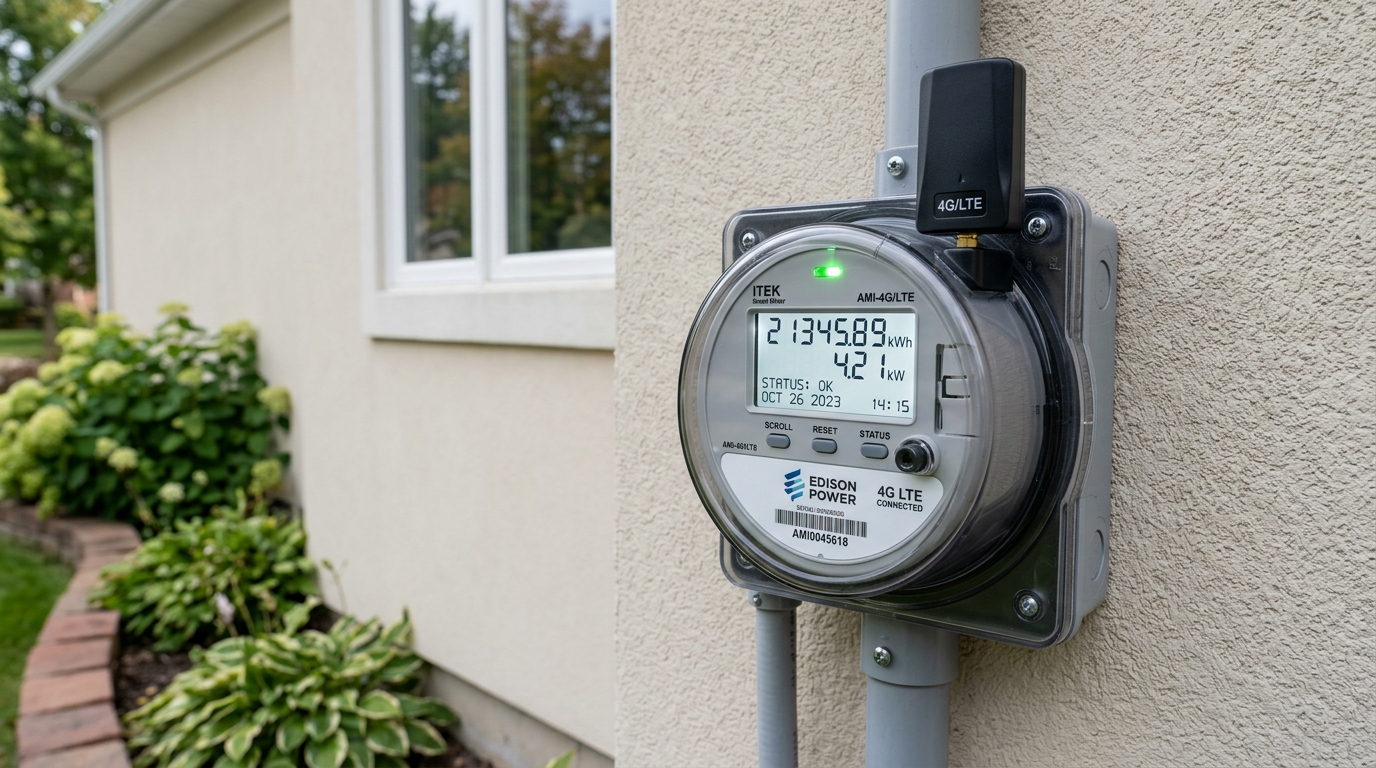
2. Eligibility Criteria & NEPRA 80% Transformer Capacity Rule
- Three-Phase Connection Mandatory: Single-phase connections are legally ineligible for net metering in Pakistan. If your house has a 1-phase meter, you must first apply for conversion to 3-phase.
- Sanctioned Load Rule: Your solar inverter AC capacity cannot exceed 100% of your sanctioned load (or 1.5 times under specific industrial exemptions). If you install a 10 kW inverter, your sanctioned load must be at least 10 kW.
- 80% Distribution Transformer Loading Ceiling: Under NEPRA regulations, cumulative solar net metering generation connected to any single distribution transformer cannot exceed 80% of the transformer kVA rating. For example, on a 100 kVA transformer, a maximum of 80 kW total solar capacity can be approved. Applying early secures transformer quota before neighbors exhaust it.
3. Official Demand Notice Fee Breakdown (2026 Schedule)
| Fee Component / Equipment | Approved Rate Range (2026) | Payable To |
|---|---|---|
| Three-Phase Bi-Directional Green Meter (Whole Current) | Rs. 32,000 – Rs. 42,000 | DISCO via NBP Bank Challan |
| Meter Testing & Calibration Fee (M&T Lab) | Rs. 4,500 – Rs. 6,500 | DISCO Revenue Account |
| Sanctioned Load Extension Fee (if increasing kW) | Rs. 1,810 per additional kW | Security Deposit adjustment |
| NEPRA License Fee (Application Processing) | Rs. 1,000 (Domestic up to 20kW) | NEPRA Treasury Account |
| Total Official Government Cost | Rs. 39,000 – Rs. 52,000 | 100% Stamped Bank Challans |
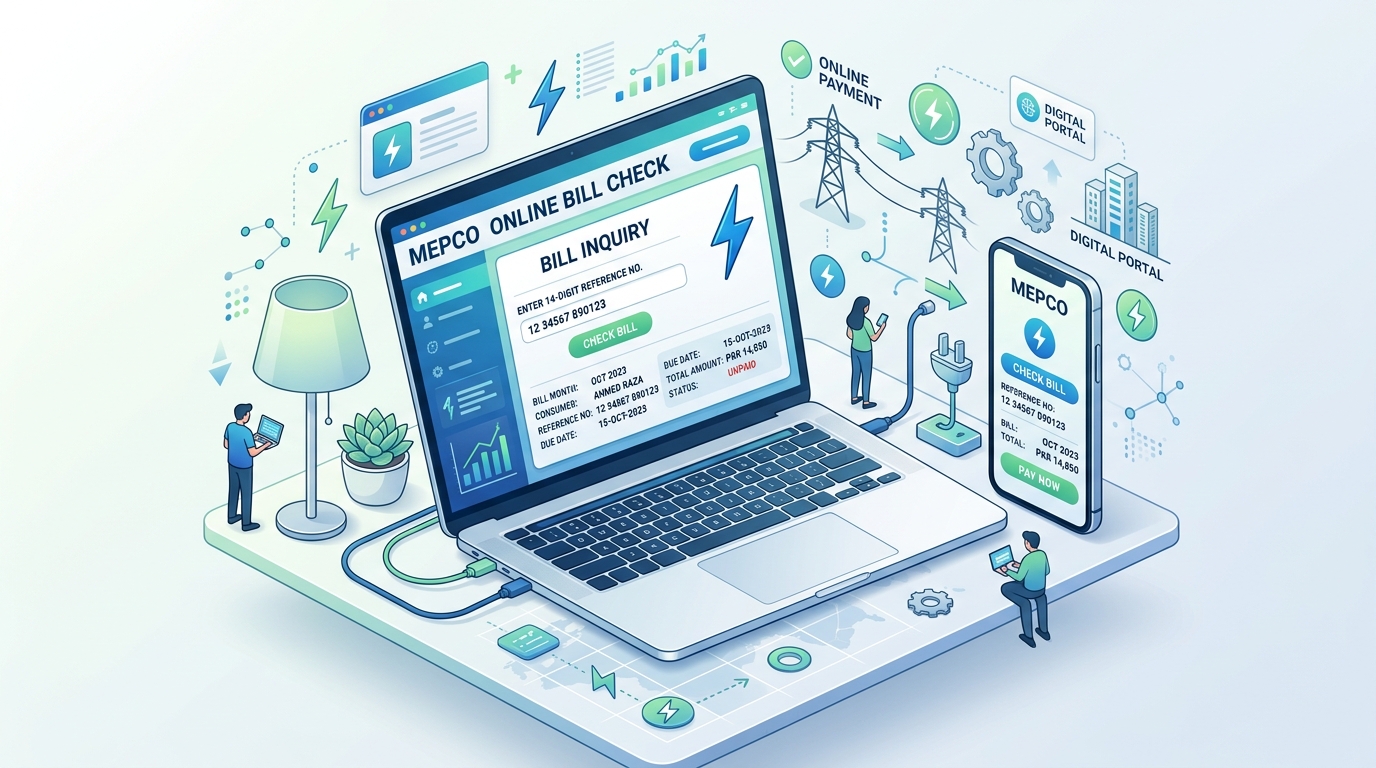
4. Step-by-Step Application Workflow: From Filing to Commissioning
- Phase 1: File Preparation by AEDB Certified Solar Vendor: Prepare single-line wiring diagrams (SLD), inverter technical datasheets, panel flash test reports, and CNIC copy.
- Phase 2: Submission to SDO / XEN Office: The application is logged in the sub-division register and forwarded to the Planning & Engineering Directorate for transformer load flow analysis.
- Phase 3: Issuance & Payment of Demand Notice: SDO issues the Demand Notice for Green Meter procurement and testing. Pay the challan and return the stamped copy.
- Phase 4: M&T Laboratory Bench Calibration: The green meter is programmed with time-of-use (TOU) tariffs and sealed with tamper-evident serial lead seals.
- Phase 5: NEPRA Generation License Generation: DISCO submits the dossier to the NEPRA online portal, which issues the official 3-year renewable Distributed Generation License.
- Phase 6: Physical Installation & Commercial COD: Linemen remove the old meter, install the Green Meter, connect external disconnect safety switches, and execute Commercial Operation Date (COD) commissioning.
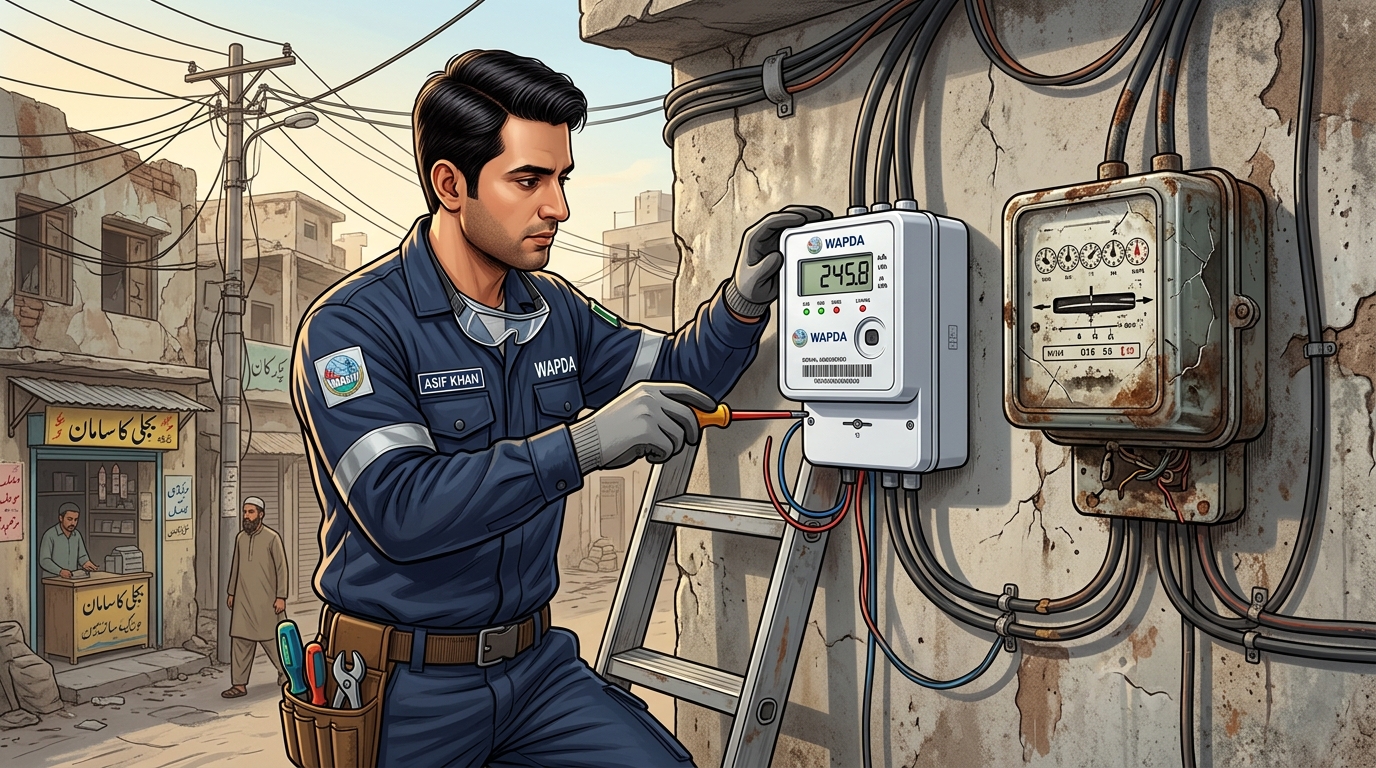
5. How Solar Credits Offset Your Monthly Utility Bill
- Peak Hours vs Off-Peak Hours: Solar power generated during the day offsets Off-Peak units 1:1. Peak units (consumed between 6:00 PM and 10:00 PM) are billed at peak rates unless excess off-peak financial credits are used to offset the net bill value.
- Rolling Unit Bank: If you export 800 units and consume 500 units, the surplus 300 units are stored in a rolling credit bank and deducted from winter heating bills when solar generation is low!
6. SDO Field Verification, Earth Resistance Testing & Billing Integration
The physical installation and official commissioning of your 3-phase bi-directional green meter marks the final administrative milestone of the NEPRA net metering workflow. Once your Demand Notice payment is completed at an authorized National Bank of Pakistan (NBP) or Bank of Punjab branch, the physical verification team coordinates with the Sub-Divisional Officer (SDO) and Line Superintendent (LS) for on-site commissioning.
To avoid field inspection rejections or bureaucratic hold-ups, prepare your domestic premises with the following mandatory engineering safeguards:
- Calibrated Testing Lab Seals (M&T Division): The physical green meter must arrive with authentic holographic tamper-evident seals and an official calibration test certificate issued by the DISCO's central Metering and Testing (M&T) division.
- Low-Impedance Earthing Pit Verification: The DISCO testing squad will measure the electrical earthing resistance using a digital earth tester. Under NEPRA Interconnection Regulations, the combined solar array structure, inverter chassis, and AC distribution box ground resistance must measure strictly below 5.0 ohms, connected via minimum 16mm² annealed copper earthing conductors.
- Anti-Islanding Safety Disconnect Test: The inspecting technician will simulate a sudden utility grid failure by opening the primary incoming AC circuit breaker while your solar inverter is feeding maximum daytime solar power. The inverter's certified anti-islanding relay must trip and disconnect AC output within exactly 2.0 seconds, eliminating utility backfeed danger to DISCO linesmen working on nearby distribution transformers.
- Meter Installation Order (MIO) Documentation: The SDO crew applies serial-numbered tamper-evident polycarbonate seals to the terminal blocks and writes down the initial 4-quadrant register readings on the physical MIO document: Import kWh, Export kWh, Peak units, and reactive kVARh. Retain a signed duplicate copy for billing reconciliation.
Your bidirectional billing profile will automatically reflect in the subsequent monthly DISCO billing cycle, converting every surplus solar unit into financial billing credits that offset winter utility consumption.
7. Frequently Asked Questions (FAQ)
Q1: How long does it take from application to Green Meter installation?
Under NEPRA statutory performance standards, the entire process must be completed within 30 to 45 calendar days. Working with a reputable Alternative Energy Development Board (AEDB) certified vendor prevents bureaucratic delays.
Q2: Can I install a Green Meter on a rented property?
Yes, provided the registered property owner signs a formal NOC (No Objection Certificate) and affidavit authorizing net metering on their reference number.
Q3: What happens if the utility grid goes down? Does my solar keep exporting?
No. Under mandatory anti-islanding safety standards (IEEE 1547 / UL 1741), on-grid inverters shut down within 100 milliseconds of a grid power failure to prevent electrocuting linemen working on overhead distribution wires.
Need to check or calculate your current utility bill?
Verify your electricity duplicate bill with instant photo-reading verification or calculate slab costs accurately.