How to Calculate Electricity Bill from Meter Reading in Pakistan: Step-by-Step Mathematical Formula with Live Slabs
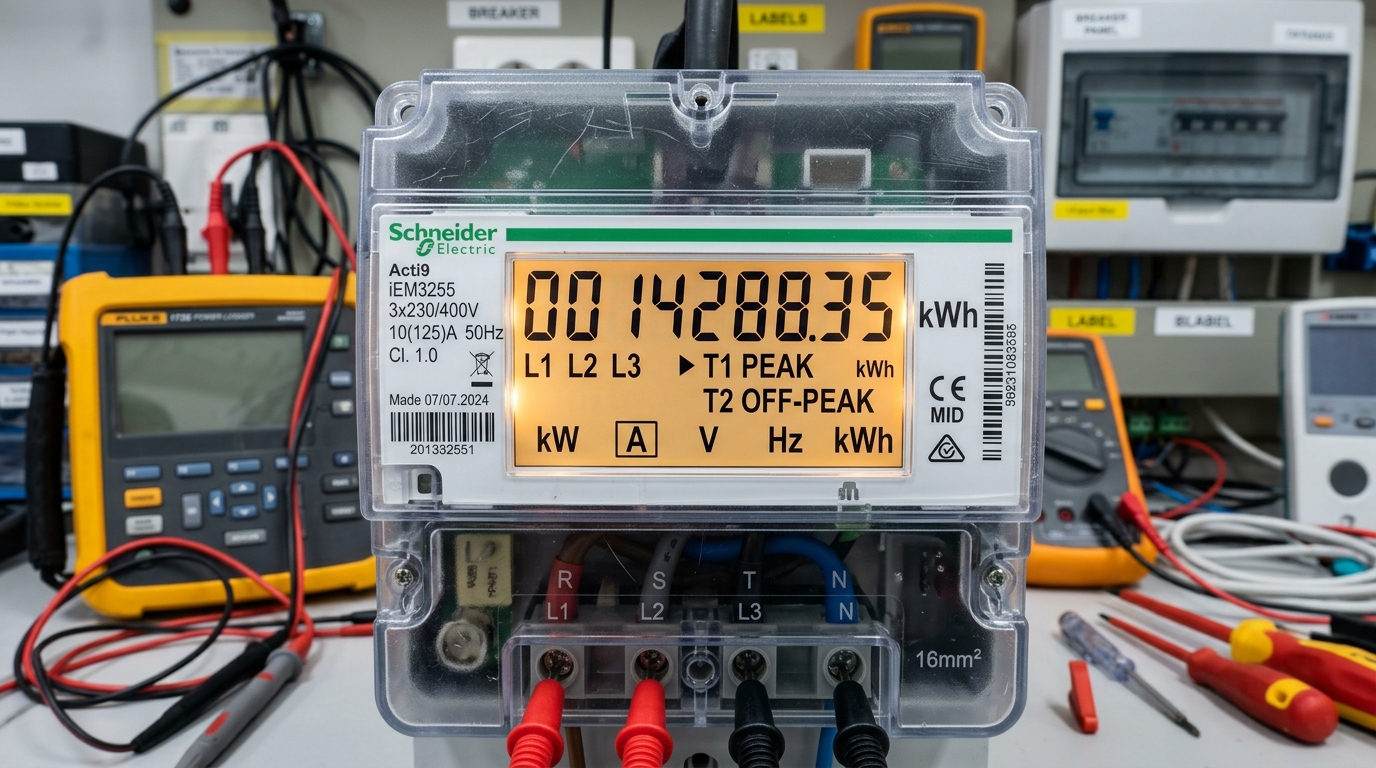
Table of Contents
- 1. Why You Must Audit Your Own Meter Reading
- 2. Step 1: Extracting Current & Previous kWh Readings from Digital Meters
- 3. Step 2: Determining Your Consumption Tier & Protected Status
- 4. Step 3: Calculating Variable Energy Charges (The Progressive Slab Math)
- 5. Step 4: Adding Surcharges (FC Surcharge, FPA & QTA)
- 6. Step 5: Applying Government Taxes (GST, ED, Advance Income Tax, PTV)
- 7. Full Mathematical Walkthrough: 235 Units Consumption Example
- 8. How to Spot Overbilling, Ghost Units & Meter Reader Errors
1. Why You Must Audit Your Own Meter Reading
Every month, millions of Pakistani power consumers receive utility bills from distribution companies (LESCO, MEPCO, IESCO, FESCO, GEPCO, PESCO, etc.) that exceed their household expectations. In many instances, inflated bills are not simply the result of higher electricity usage; they are triggered by meter reading schedule extensions (e.g. 33 or 35 billing days instead of 30), erroneous manual meter reader data entry, or arbitrary detection estimates.
Because Pakistan's progressive tariff structure applies severe financial penalties the moment a household crosses the 200 or 300 unit threshold, an unverified discrepancy of just 5 or 10 units can trigger a 200% surge in your total payable amount. Knowing how to calculate your bill directly from the numbers displayed on your digital LCD meter empowers you to detect overbilling immediately, contest erroneous bills before the due date, and manage daily consumption proactively.
2. Step 1: Extracting Current & Previous kWh Readings from Digital Meters
Modern digital electricity meters (single-phase static LCD meters) installed throughout Pakistan cycle automatically through multiple diagnostic displays every 5 to 6 seconds. To calculate your bill, you must record the correct display register:
- Display Screen 01 (Display Test / Serial Number): All segments illuminate (888888) followed by the meter internal serial number.
- Display Screen 02 (Instantaneous kW Load): Displays current real-time electrical draw in kilowatts (e.g.,
1.45 kW). This is not your billing units. - Display Screen 03 (Cumulative Active Energy - Total kWh): This is the primary reading you need. It displays total kilowatt-hours consumed since the meter was installed, labeled with the code
kWhon the bottom right (e.g.,014892 kWh). - Display Screen 04/05 (Peak / Off-Peak kWh for 3-Phase Meters): On 3-phase meters, Register 01 represents Total kWh, Register 02 represents Off-Peak kWh (T1), and Register 03 represents Peak Hours kWh (T2).
Total Units Consumed = Present Cumulative kWh Reading − Previous Month Billed kWh ReadingExample: If your previous paper bill ended at 14,520 kWh and your physical meter LCD reads 14,755 kWh on billing day, your monthly consumption is 14,755 − 14,520 = 235 Units.
3. Step 2: Determining Your Consumption Tier & Protected Status
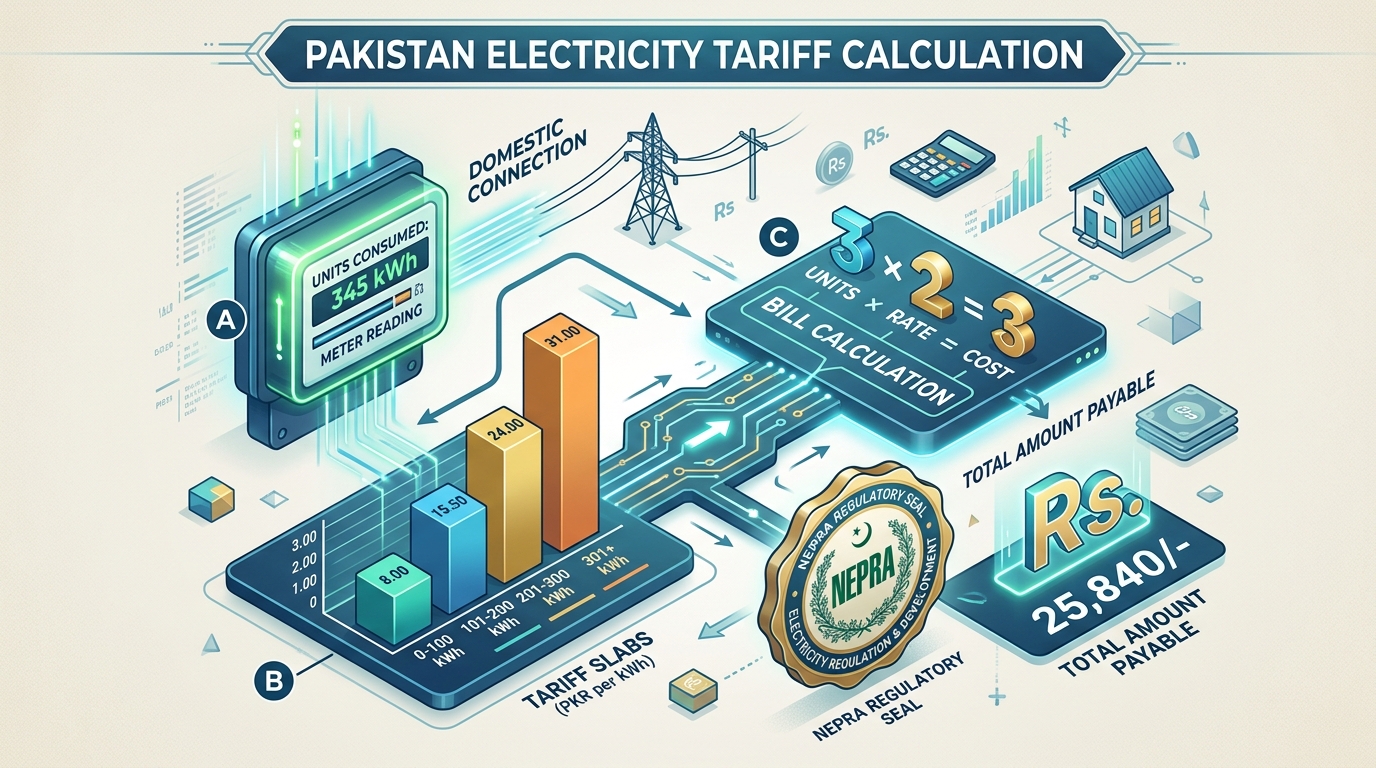
Before applying unit rates, determine which consumer classification applies to your connection:
- Protected Status: If your monthly usage has remained at or below 200 units for the preceding 6 consecutive billing months, your units are calculated under subsidized Protected Slabs (Rs. 7.74/unit for 1–100, Rs. 14.16/unit for 101–200).
- Unprotected Status: If your units exceed 200 units in the current month, or if you breached 200 units anytime in the preceding 6 months, you are billed under Unprotected Slabs.
4. Step 3: Calculating Variable Energy Charges (The Progressive Slab Math)
Unlike commercial billing where a flat rate applies to all units, domestic residential electricity in Pakistan utilizes cumulative progressive blocks. If an unprotected consumer uses 250 units, the units are segmented across tiers:
| Consumption Slab Bracket | Units in This Tier | Unprotected Base Rate | Tier Energy Cost |
|---|---|---|---|
| Slab 1 (Units 001 to 100) | 100 Units | Rs. 23.59 / kWh | Rs. 2,359.00 |
| Slab 2 (Units 101 to 200) | 100 Units | Rs. 30.07 / kWh | Rs. 3,007.00 |
| Slab 3 (Units 201 to 300) | Remaining 35 Units (for 235 total) | Rs. 34.26 / kWh | Rs. 1,199.10 |
| Total Base Variable Energy Charges: | Rs. 6,565.10 | ||
5. Step 4: Adding Surcharges (FC Surcharge, FPA & QTA)
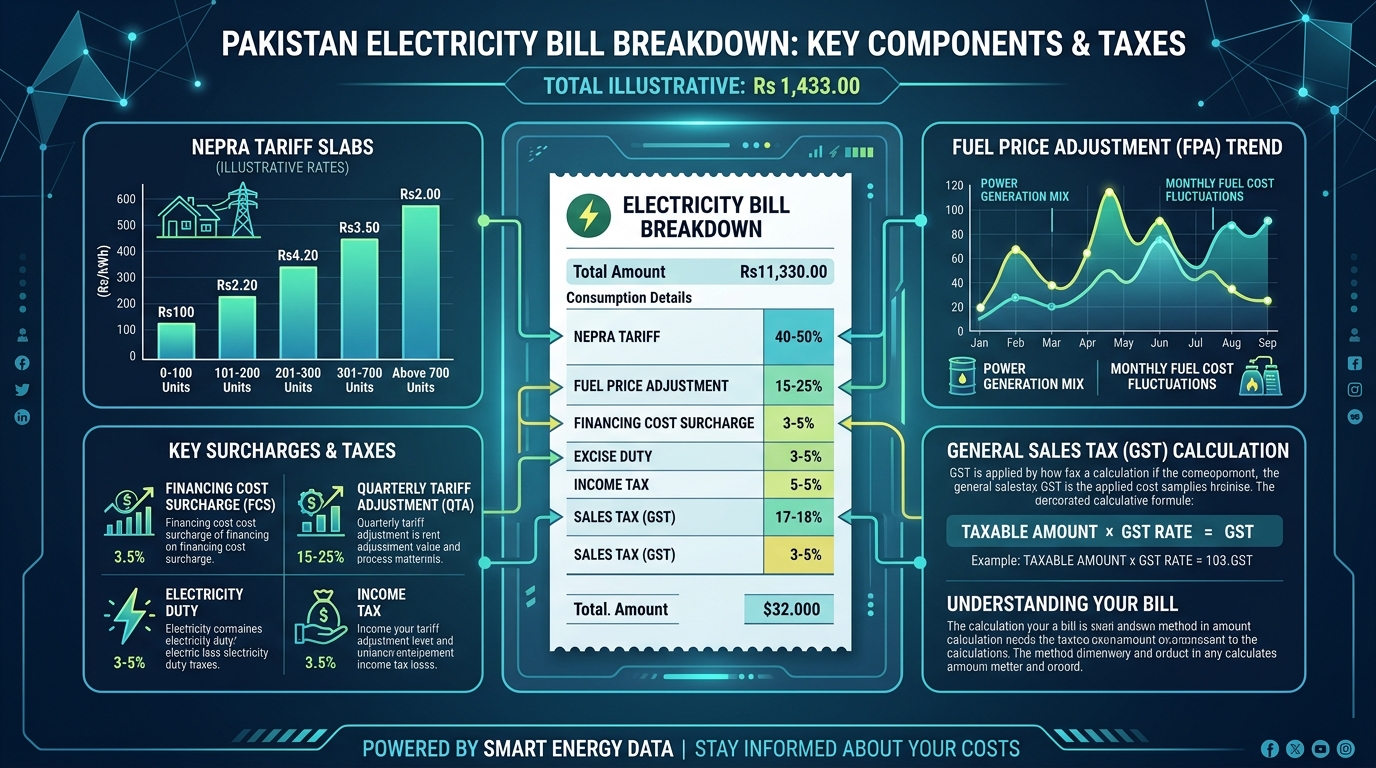
Next, statutory surcharges are added based directly on the total unit volume consumed (235 units):
- Financing Cost (FC) Surcharge: Imposed at Rs. 3.23 per kWh:
235 units × Rs. 3.23 = Rs. 759.05 - Fuel Price Adjustment (FPA): Estimated monthly generation fuel delta (assume Rs. 2.45/kWh for the current cycle):
235 units × Rs. 2.45 = Rs. 575.75 - Quarterly Tariff Adjustment (QTA): Capacity and currency adjustment (assume Rs. 1.65/kWh):
235 units × Rs. 1.65 = Rs. 387.75
Subtotal before Government Taxes:
Rs. 6,565.10 (Base) + Rs. 759.05 (FC) + Rs. 575.75 (FPA) + Rs. 387.75 (QTA) = Rs. 8,287.65
6. Step 5: Applying Government Taxes (GST, ED, Advance Income Tax, PTV)
Government levies are applied sequentially according to statutory fiscal formulas:
- General Sales Tax (GST @ 18%): Assessed on the gross subtotal of energy charges and surcharges:
Rs. 8,287.65 × 18% = Rs. 1,491.78 - Electricity Duty (ED @ 1.5%): Assessed on base variable energy charges:
Rs. 6,565.10 × 1.5% = Rs. 98.48 - PTV License Fee: Mandatory statutory monthly charge = Rs. 35.00
- Advance Income Tax (Section 235): Applies only if total monthly bill exceeds Rs. 25,000 for non-filers. Since this bill is under Rs. 25,000, Advance Tax = Rs. 0.00.
7. Full Mathematical Walkthrough: 235 Units Consumption Example
Aggregating all verified line items produces the final payable figure:
| Billing Line Item | Calculation Basis | Amount (PKR) |
|---|---|---|
| Base Energy Charges (1–100 Units) | 100 Units × Rs. 23.59 | Rs. 2,359.00 |
| Base Energy Charges (101–200 Units) | 100 Units × Rs. 30.07 | Rs. 3,007.00 |
| Base Energy Charges (201–235 Units) | 35 Units × Rs. 34.26 | Rs. 1,199.10 |
| Financing Cost (FC) Surcharge | 235 Units × Rs. 3.23 | Rs. 759.05 |
| Fuel Price Adjustment (FPA) | 235 Units × Rs. 2.45 | Rs. 575.75 |
| Quarterly Tariff Adjustment (QTA) | 235 Units × Rs. 1.65 | Rs. 387.75 |
| General Sales Tax (GST 18%) | 18% of Subtotal (Rs. 8,287.65) | Rs. 1,491.78 |
| Electricity Duty (1.5%) | 1.5% of Base Energy (Rs. 6,565.10) | Rs. 98.48 |
| PTV License Fee | Fixed Residential Fee | Rs. 35.00 |
| Total Bill Payable Within Due Date: | Rs. 9,913.00 | |
In this scenario, the effective out-of-pocket rate paid per unit is Rs. 42.18 per kWh (Rs. 9,913 ÷ 235 units)—substantially higher than the basic tier rate printed on the bill header.
8. How to Spot Overbilling, Ghost Units & Meter Reader Errors
Equipped with this mathematical formula, you can immediately identify utility irregularities:
- Check the Meter Reading Date on Your Bill: NEPRA rules mandate that billing cycles must span 28 to 31 days. If your bill indicates a 34 or 36-day cycle, the extra 4 days of consumption may push you past your 200 or 300 unit slab ceiling. You have the legal right under the NEPRA Consumer Service Manual (CSM) to demand a pro-rata slab adjustment.
- Compare the Printed Meter Snapshot: DISCO bills include a digital photograph of your meter taken by the meter reader. Verify that the numbers displayed on the physical LCD photograph match the 'Present Reading' column on your bill. If the meter reader entered 14,850 but the photo displays 14,650, you are being billed for 200 ghost units.
- Immediate Rectification Procedure: Take a high-resolution smartphone photo of your meter screen showing the date and current reading. File an online billing discrepancy complaint via the CCMS portal or present the photo directly to your local Sub-Divisional Officer (SDO), who is legally empowered to issue an amended computerized bill within 24 hours.
Frequently Asked Questions (FAQs)
Verify Your Utility Bill Online Now
Want to check your live DISCO electricity bill or calculate your monthly cost based on your latest meter reading? Use our free, real-time tools updated with the latest 2026 NEPRA tariffs: