1. The Industrial Power Dilemma: When to Transition from Low Tension to High Tension
Across Pakistan's rapidly expanding commercial, manufacturing, and agricultural sectors—encompassing textile dyeing units, flour mills, cold storage facilities, ice factories, plastic molding plants, steel fabrication workshops, private hospital complexes, and multi-story commercial shopping plazas—the cost, reliability, and technical quality of electrical energy dictate commercial viability. Under the aggressive tariff escalation policies implemented by the National Electric Power Regulatory Authority (NEPRA), industrial electricity rates have climbed to historic heights, making electrical overhead the single largest operational expenditure for Pakistani business owners.
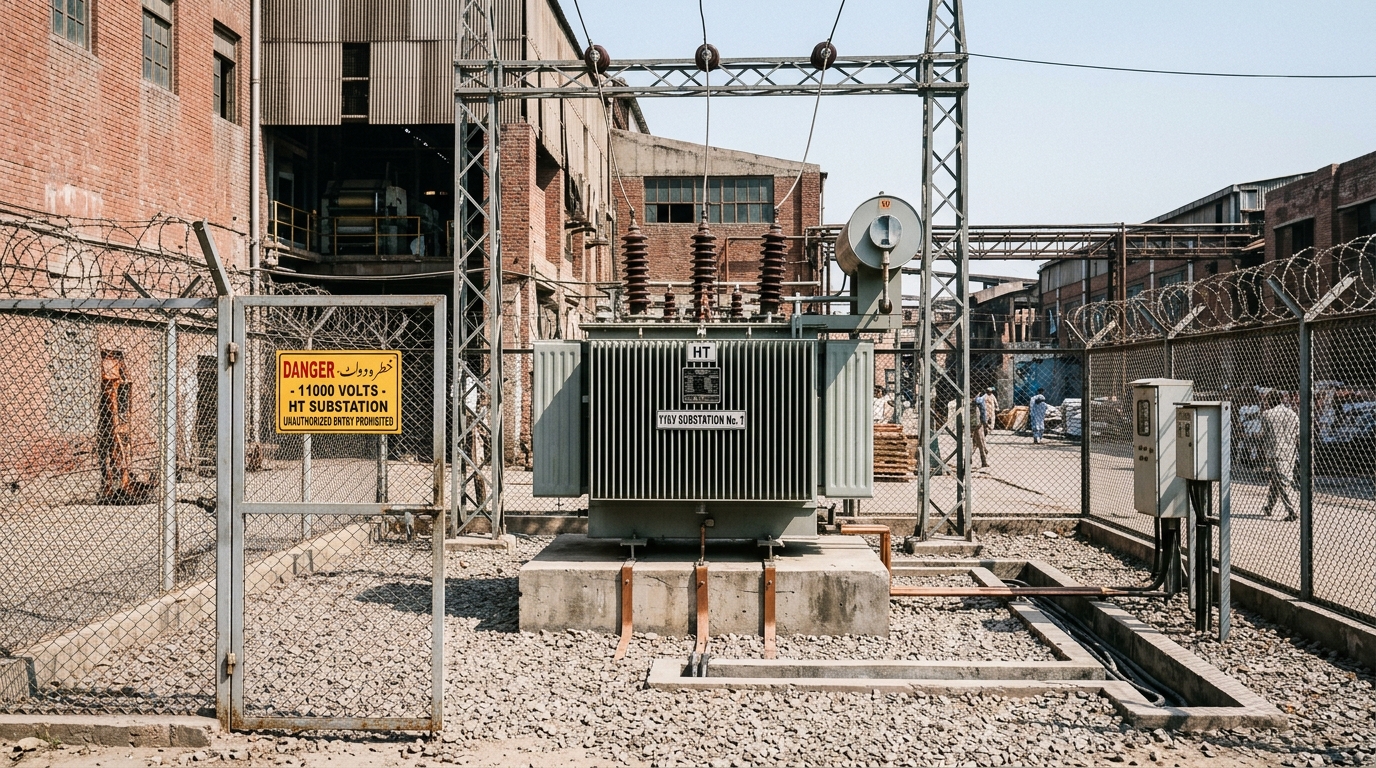
When an enterprise expands its manufacturing footprint or adds heavy motor loads (such as large air compressors, injection molding presses, chillers, or extrusion lines), it rapidly reaches the maximum load capacity of its existing electrical service. At this critical juncture, business executives and factory owners face a profound strategic engineering decision: Should the enterprise continue operating on a standard Low Tension (400V LT) supply, or invest millions of rupees in civil and electrical infrastructure to transition to a dedicated High Tension (11,000V HT) primary grid connection?
This decision involves complex technical and financial tradeoffs. While an HT connection requires massive upfront capital expenditure—including the procurement of an oil-immersed step-down distribution transformer, high-voltage Vacuum Circuit Breakers (VCBs), drop-out cutouts, and a dedicated concrete substation room—it unlocks substantially cheaper bulk industrial tariff rates (Tariff B-2 and B-3), eliminates chronic low-voltage motor burnouts, avoids penal line loss charges, and provides immense operational scalability. In this authoritative engineering manual, BillsOnlinePk provides an exhaustive analysis of HT versus LT power dynamics in Pakistan, detailing capital costs, tariff rate structures, MDI billing mechanics, and exact payback formulas.
Regulatory Threshold: Under NEPRA and DISCO distribution codes across Pakistan (MEPCO, LESCO, FESCO, GEPCO, IESCO, PESCO, and K-Electric), any commercial or industrial customer applying for a sanctioned load exceeding 50 kW (or 70 kW in certain jurisdictions) is legally mandated to install a dedicated private distribution transformer and migrate to High Tension (HT) metering.
2. Engineering Definitions: 400V Low Tension (LT) vs 11,000V High Tension (HT) Architecture
To grasp the profound economic difference between HT and LT power supply, one must examine the fundamental electrical physics governing power distribution:
- Low Tension (LT) Supply (400 Volts Three-Phase / 230 Volts Single-Phase): Under an LT connection, electricity is delivered from a shared, utility-owned pole-mounted distribution transformer located on the public street. Power flows into your facility through low-voltage overhead service drop wires or underground cables at standard consumer utilization voltage (400V line-to-line, 50 Hz). Because voltage is low, electric current ($I = P / [sqrt{3} imes V imes cos heta]$) is extremely high. High current flowing through long cables generates severe resistive line losses ($I^2 imes R$) and significant voltage drop, causing supply voltage to collapse to 340V or lower during peak summer hours, causing electric motors to draw excessive current, overheat, and burn out.
- High Tension (HT) Supply (11,000 Volts Three-Phase): Under an HT connection, the utility delivers raw primary feeder power directly from the 132kV/11kV grid substation at 11 kV (11,000 Volts AC) directly to the customer’s private boundary wall. Because the distribution voltage is 27.5 times higher than LT voltage, the required transmission current is 27.5 times lower! Consequently, transmission line losses are negligible, and voltage remains rock-solid and stable regardless of how heavily neighboring consumers load the public grid. The customer owns, operates, and maintains their own dedicated step-down transformer to convert 11kV into 400V locally.
3. NEPRA Regulatory Thresholds: Sanctioned Load Limits for B-1, B-2 & B-3 Tariffs
In Pakistan, industrial customers are classified under NEPRA’s Tariff Category B, which is subdivided into distinct tiers based on sanctioned load and supply voltage:
| Industrial Tariff Category | Sanctioned Load Range | Supply Voltage Level | Metering Infrastructure & Ownership |
|---|---|---|---|
| Tariff B-1 (a) | Up to 25 kW | 230V Single-Phase or 400V LT Three-Phase | Standard whole-current digital static meter; utility transformer. |
| Tariff B-1 (b) | Above 25 kW up to 50 kW (or 70 kW in LESCO) | 400V LT Three-Phase | Current Transformer (CT) operated LT meter; shared utility transformer. |
| Tariff B-2 (a) [LT Supply] | Above 50 kW up to 500 kW | 400V LT Supply (Utility Transformer) | LT CT-operated TOU meter; consumer pays special transformer augmentation charges. |
| Tariff B-2 (b) [HT Supply] | Above 50 kW up to 500 kW (Standard Industrial) | 11,000V (11 kV) HT Primary Supply | Dedicated Private Substation: 11kV CT/PT unit; HT TOU electronic meter. |
| Tariff B-3 | Above 500 kW up to 5,000 kW (5 MW) | 11 kV or 33 kV Primary HT Grid Feeder | Dedicated independent 11kV express feeder from grid substation; indoor VCB panel. |
| Tariff B-4 | Above 5,000 kW (5 MW and above) | 66 kV or 132 kV Extra High Tension (EHT) | Private 132kV dedicated grid substation on consumer premises. |
4. Dedicated Substation Hardware & Capital Costs: Transformers (100kVA-630kVA) & VCBs
Transitioning to an HT connection requires establishing a fully compliant private substation. In Pakistan, the major equipment components and their prevailing 2026 market capital costs include:
- Oil-Immersed Step-Down Distribution Transformer (11kV / 0.415kV): Manufactured by certified Pakistani manufacturers (such as Siemens, PEL, Transfopower, Pak Elektron Limited, or Meeco):
- 100 kVA Transformer (approx. 80 kW load): PKR 1,150,000 - 1,450,000
- 200 kVA Transformer (approx. 160 kW load): PKR 1,750,000 - 2,100,000
- 400 kVA Transformer (approx. 320 kW load): PKR 2,800,000 - 3,400,000
- 630 kVA Transformer (approx. 500 kW load): PKR 4,200,000 - 4,900,000
- 11kV High-Voltage Switchgear & Protection:
- Drop-Out (DO) Fuse Cutouts & 11kV Lightning Arresters (LA): Mounted on the H-pole structure (PKR 120,000 - 180,000).
- Vacuum Circuit Breaker (VCB) Indoor Panel (11kV, 630A, 25kA breaking capacity): Essential for loads above 200 kW to provide microsecond over-current and earth fault trip protection (PKR 1,400,000 - 2,200,000).
- 11kV Combined Metering Unit (KWH / KVARH CT/PT Unit): Certified by the DISCO Meter Testing & Inspection (M&T) laboratory (PKR 350,000 - 550,000).
- Civil Substation Room & Chemical Earthing: Mandatory concrete transformer pad, blast-resistant oil containment pit, gravel soak-away, and three dedicated chemical earth pits achieving < 1.0 Ohm resistance (PKR 450,000 - 750,000).
- DISCO Security Deposit & Capital Contribution: Cash security deposit paid directly to the utility based on sanctioned kW load, plus costs for extending the 11kV overhead line conductors (PKR 800,000 - 2,500,000).
Total Capital Outlay: Setting up a turnkey 200 kVA dedicated HT substation in Pakistan currently requires a total capital investment ranging between PKR 4.8 million and PKR 6.5 million.
5. Comprehensive Tariff Comparison: LT B-1 / B-2 vs HT B-2 / B-3 Rates & Peak Surcharges
Why would a factory owner spend 5 million rupees to install a private transformer? The economic answer lies in the massive divergence between NEPRA’s Low Tension and High Tension tariff schedules:
| Billing Parameter | LT Industrial Tariff B-1 (b) / B-2 (a) | HT Industrial Tariff B-2 (b) [11kV] | Net Financial Advantage of HT Supply |
|---|---|---|---|
| Off-Peak Energy Rate (Per kWh) | PKR 42.50 - 45.80 / Unit | PKR 34.20 - 37.10 / Unit | PKR 7.50 - 8.70 Cheaper per Unit! |
| Peak Hours Energy Rate (Per kWh) | PKR 58.00 - 64.50 / Unit | PKR 49.50 - 54.20 / Unit | PKR 8.50 - 10.30 Cheaper per Unit! |
| Fixed Capacity Charges (Per kW MDI) | PKR 500 - 600 / kW / Month | PKR 1,250 - 1,450 / kW / Month | HT has higher fixed charge, but lower unit energy rate. |
| Mandatory Line Loss Surcharge | +2.0% to +3.5% added to bill | 0.0% (Zero loss surcharge) | Eliminates phantom line loss billing charges. |
| Power Factor Penalty Threshold | Penalized if PF < 0.90 lagging | Penalized if PF < 0.90 lagging | Identical; easily managed with automatic APFC panel. |
For an industrial consumer operating multiple shifts, the PKR 8.00 per unit savings on energy charges completely eclipses the higher monthly fixed capacity charge!
6. Maximum Demand Indicator (MDI) Mechanics & Fixed Capacity Charges
Both LT B-2 and HT B-2/B-3 accounts are billed under a two-part tariff structure comprising an Energy Charge (kWh) and a Fixed Capacity Charge (kW of MDI):
- What is MDI? The Maximum Demand Indicator (Code 14 on the digital billing meter) continuously records the highest average electrical load (in kilowatts) drawn by the customer over any continuous 30-minute integration window during the entire billing month.
- The 50% Billing Sanctioned Rule: Under NEPRA regulations, you are billed for Fixed Capacity Charges based on either:
- Your actual recorded peak MDI during the month, OR
- 50 percent of your officially sanctioned load, whichever is higher!
Crucial Operational Strategy: If you sanction a 200 kW HT connection but your factory runs at only 40 kW MDI, you will still be forcibly billed for 100 kW of Fixed Charges (100 kW × 1,350 PKR = PKR 135,000 monthly)! Industrial managers must carefully audit their operational machinery and stagger motor startups to prevent brief, accidental 30-minute demand spikes from locking in crippling MDI capacity bills for the entire month.
7. Transmission Line Losses & Metering Location: HT Primary vs LT Secondary Metering
Where the electricity meter is physically connected has a direct financial impact on your bill:
- HT Primary Metering (Preferred Standard): The meter is connected directly to the 11kV primary feeder side via oil-immersed 11kV Potential Transformers (PT) and Current Transformers (CT). The consumer pays for raw 11kV energy, and all internal transformer no-load core losses (iron losses) and winding copper losses are absorbed by the consumer. In return, the utility provides the lowest baseline tariff rate.
- LT Secondary Metering with Transformation Penalty: If a consumer owns an HT transformer but the DISCO installs the meter on the low-voltage 400V secondary side (due to shortage of 11kV metering units):
- The DISCO adds a mandatory 2.5% to 3.0% Virtual Transformation Loss Penalty onto the printed monthly bill!
- The bill also adds No-Load Fixed Units (typically 400 to 900 kWh/month) representing continuous magnetizing core losses.
8. Step-by-Step Procedure for Applying for an HT Industrial Connection in Pakistan
To transition an existing factory or commercial plaza to a dedicated High Tension connection, execute this legal procedure:
- Submit Load Extension Application: File an online application on the official DISCO Electricity New Connection (ENC) portal (enc.com.pk) selecting "Industrial Tariff B-2 HT" or "Commercial Tariff A-2 HT", uploading CNIC, property ownership documents, and an approved machinery single-line diagram (SLD).
- Site Feasibility Survey: The DISCO Planning & Engineering (P&E) Department inspects the site, identifies the nearest 11kV distribution feeder, and calculates available substation transformer capacity. If the feeder is overloaded, you may be required to pay for an express feeder bifurcation.
- Issuance of Demand Notice (DN): The DISCO issues a formal Demand Notice containing security deposits, line development fees, and M&T inspection charges. Pay at designated bank branches.
- Substation Construction: Procure certified transformer and VCB switchgear from pre-qualified AEDB/DISCO approved manufacturers. Build the civil substation room and install certified chemical earth pits.
- Provincial Electric Inspector (PEI) NOC: An authorized government Electrical Inspector inspects insulation resistance (Megger test), earth pit resistance (< 1.0 Ohm), VCB relay trip calibration, and issues a formal "Certificate of Fitness" (Form A).
- M&T Meter Installation & Energization: The DISCO Meter Testing team installs and seals the electronic HT billing meter. The utility lineman closes the 11kV gang-operated air-break switch, energizing your private substation.