
1. The Bifacial Revolution in Pakistan: Why Double-Sided Solar is Dominating 2026
Over the past three years, Pakistan's distributed solar photovoltaic landscape has experienced a monumental technological evolution. As retail grid electricity tariffs under the National Electric Power Regulatory Authority (NEPRA) surged past 65 Pakistani Rupees per kilowatt-hour (kWh) for peak-slab residential and commercial consumers, Pakistani households, agricultural tubewell operators, and industrial enterprises have aggressively migrated to high-efficiency solar architectures. Among the most impactful innovations driving maximum yield per square foot of rooftop space is the commercial adoption of double-glass bifacial solar photovoltaic modules.
Unlike conventional monofacial solar panels—which possess an opaque, white or black backsheet that absorbs zero incoming radiation from the rear side—bifacial solar panels are engineered with transparent dual-tempered glass or transparent backsheet encapsulation. This design allows the photovoltaic cells to absorb not only direct sunlight and diffuse sky radiation from the front face, but also scattered, reflected, and diffuse ambient light from the backside of the module. In Pakistan's climatic conditions, where high solar irradiance is frequently accompanied by scorching ambient temperatures reaching 45 degrees Celsius to 48 degrees Celsius in regions like Multan, Faisalabad, Sukkur, and Sibi, bifacial technology delivers extraordinary advantages that directly translate into higher units generated and drastically reduced monthly electricity bills.
However, extracting the promised 10 percent to 25 percent rear-side energy yield boost requires far more than simply bolting bifacial panels onto standard iron mounting structures. Ground albedo (the reflectivity coefficient of the underlying surface), structural elevation height, string pitch clearance, tilt angle, and inverter maximum power point tracking (MPPT) sizing parameters must all be harmonized according to rigorous photovoltaic engineering principles. In this comprehensive guide, BillsOnlinePk provides an exhaustive, data-driven analysis of bifacial solar engineering, empirical field generation data across Pakistan's major geographic zones, exact capital cost comparisons, and step-by-step structural recommendations.
Key Engineering Rule: A bifacial solar panel installed flat against a dark bitumen roof produces virtually identical output to a standard monofacial panel. To unlock rear-side energy gain, the panel must be elevated at least 1.0 to 1.5 meters above the surface and positioned over a high-albedo reflective surface such as white elastomeric roof paint, polished white terrazzo tiles, or light-colored gravel.
2. Physics of Bifaciality: Front vs Rear Energy Absorption Explained
To understand the mechanics of bifacial solar generation, electrical engineers evaluate the parameter known as the Bifaciality Factor (φ). The bifaciality factor represents the ratio of the nominal efficiency or power output measured on the rear side of the module to the nominal power output measured on the front side under Standard Test Conditions (STC: 1000 W/m² irradiance, 25°C cell temperature, AM 1.5 spectral distribution):
Bifaciality Factor (φ) = (P_rear,STC / P_front,STC) × 100%
In older P-Type Mono PERC (Passivated Emitter and Rear Cell) bifacial modules, the bifaciality factor typically hovered between 65 percent and 72 percent. This limitation arose because P-type silicon wafers suffer from higher boron-oxygen defect recombination and require thicker rear-side aluminium grids that partially obstruct rear light absorption. Conversely, modern N-Type TOPCon (Tunnel Oxide Passivated Contact) and Silicon Heterojunction (HJT) architectures achieve bifaciality factors ranging from 80 percent to an astonishing 92 percent. Because N-type wafers utilize phosphorus doping rather than boron, they eliminate Light-Induced Degradation (LID) and allow symmetric passivated contact layers on both faces of the silicon wafer.
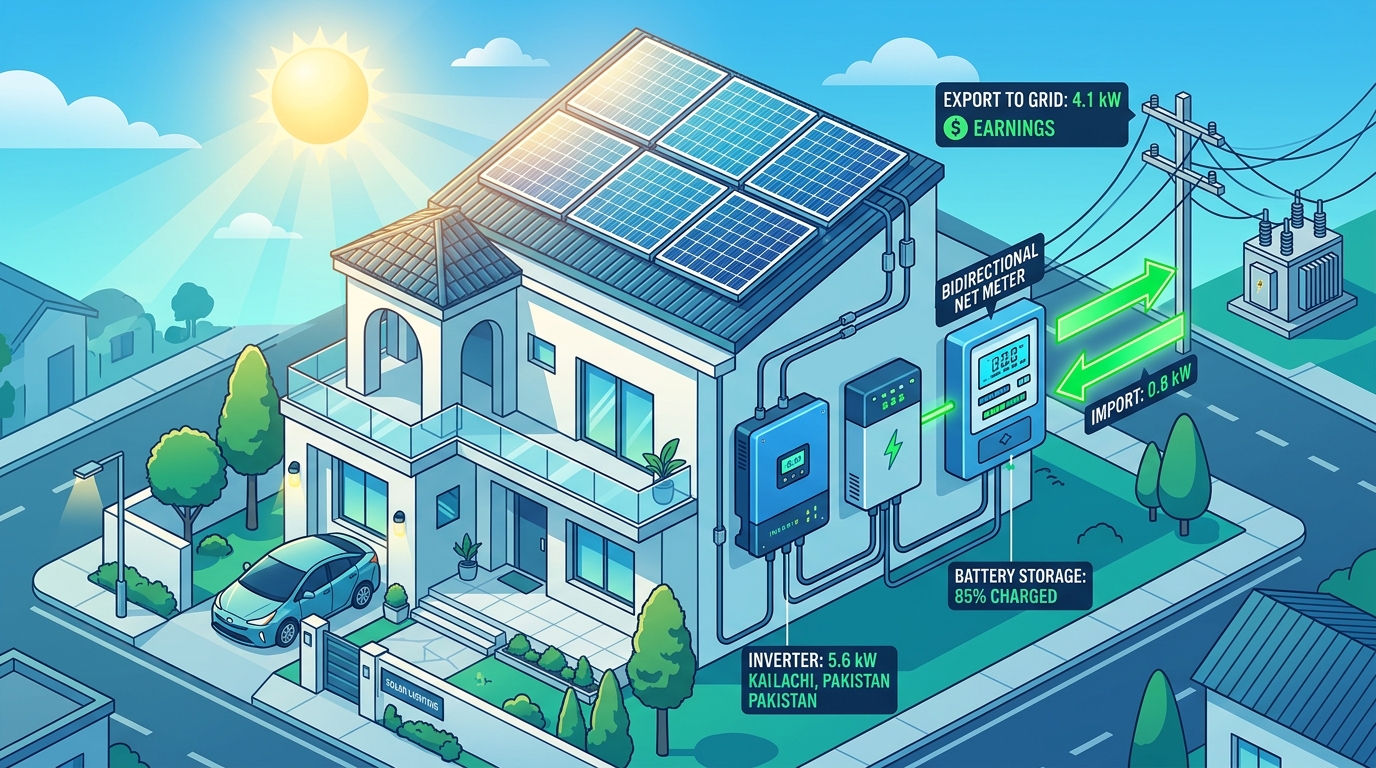
Furthermore, dual-glass bifacial panels feature double layers of 2.0mm or 3.2mm heat-strengthened glass. This construction provides robust mechanical stiffness, total impermeability to atmospheric moisture ingress, and superior fire resistance (Class A fire rating). In coastal Pakistani environments such as Karachi and Gwadar, where salt spray, coastal humidity, and sand abrasion rapidly degrade organic polymer backsheets on conventional monofacial panels, dual-glass bifacial panels exhibit near-zero Potential-Induced Degradation (PID), guaranteeing linear power output warranties spanning 30 years rather than the standard 25-year limit.
| Cell Architecture | Wafer Type | Bifaciality Factor (φ) | Temperature Coefficient (Pmax) | First-Year Degradation | 30-Year Retained Output |
|---|---|---|---|---|---|
| Standard Monofacial PERC | P-Type | 0% (Opaque Back) | -0.35% / °C | 2.00% | 84.8% (25-Year) |
| Bifacial Mono PERC | P-Type | 68% - 72% | -0.34% / °C | 1.80% | 85.4% (30-Year) |
| N-Type TOPCon Bifacial | N-Type | 80% - 85% | -0.30% / °C | 1.00% | 87.4% (30-Year) |
| Heterojunction (HJT) Bifacial | N-Type | 88% - 92% | -0.26% / °C | 1.00% | 90.2% (30-Year) |
3. Understanding Ground Albedo: Concrete vs White Reflective Paint vs Green Lawn
The total electrical energy generated by a bifacial solar array is mathematically modeled as the sum of front-side direct irradiance (G_front) and rear-side diffuse irradiance (G_rear). While the front face receives irradiance directly from the sun and sky dome, the rear face irradiance depends almost entirely on the surface albedo (α), which is the fraction of total incident light reflected by the ground or rooftop surface back into the atmosphere:
G_effective = G_front + (G_rear × φ) where G_rear ≈ G_global × α × VF_ground
Here, VF_ground represents the View Factor between the rear side of the panel and the reflective ground plane. If the ground surface is dark, absorptive, or shaded by low-mounted panels, the albedo α drops precipitously, rendering the bifacial feature ineffective. Pakistani roofs present diverse structural and architectural surfaces, each yielding vastly differing albedo ratings.
| Rooftop / Ground Surface Material | Measured Albedo Coefficient (α) | Expected Rear-Side Gain (%) | Estimated Annual kWh Boost (10kW System) | Practical Suitability for Pakistan |
|---|---|---|---|---|
| Standard Weathered Grey Concrete Roof | 0.20 - 0.25 | 4.5% - 7.0% | 720 - 1,120 kWh | Common residential baseline; modest gain without additional treatment. |
| Traditional Red Clay Tiles / Brick Pavers | 0.15 - 0.20 | 3.0% - 5.0% | 480 - 800 kWh | Poor reflectivity; absorbs heat and degrades thermal performance. |
| Light Beige Terrazzo / Marble Chips | 0.30 - 0.38 | 7.5% - 10.5% | 1,200 - 1,680 kWh | Excellent natural domestic surface found across upper Punjab & Karachi. |
| White Elastomeric Roof Coating / Acrylic Paint | 0.65 - 0.82 | 14.0% - 22.0% | 2,240 - 3,520 kWh | Maximum performance boost; simultaneously lowers building heat load. |
| Green Grass / Agricultural Tubewell Soil | 0.18 - 0.23 | 4.0% - 6.5% | 640 - 1,040 kWh | Standard for ground-mounted agricultural tubewells in Sindh & Punjab. |
| Crushed White Limestone / River Gravel | 0.50 - 0.60 | 11.0% - 16.0% | 1,760 - 2,560 kWh | Ideal for commercial factory ground plots and farm utility perimeters. |
As demonstrated in the empirical data above, applying a high-durability white elastomeric solar-reflective coating onto a standard concrete roof can more than triple the rear-side generation gain. On a typical 10 kW residential solar system in Pakistan generating 16,000 kWh annually from front irradiance, an 18 percent bifacial boost adds an extra 2,880 kWh per year. Under current NEPRA non-protected domestic billing slabs averaging 62 Rs per unit, that single coating application yields an additional 178,560 Pakistani Rupees in electricity bill savings annually, completely recovering the cost of the roof coating within four to six months.
4. Critical Installation Geometry: Ground Clearance Height & Tilt Angle Optimization
One of the most frequent installation errors committed by novice solar contractors in Pakistan is installing bifacial panels on low-profile L2 or L3 galvanized iron frames with only 30 centimeters (1 foot) of ground clearance. When a solar panel is situated too close to the roof surface, two catastrophic phenomena occur: first, the panel's own shadow completely blankets the ground directly underneath it, suffocating the diffuse light that would otherwise bounce onto the rear cells; second, the View Factor (VF_ground) approaches zero at the center of the module array, creating severe localized string mismatch.
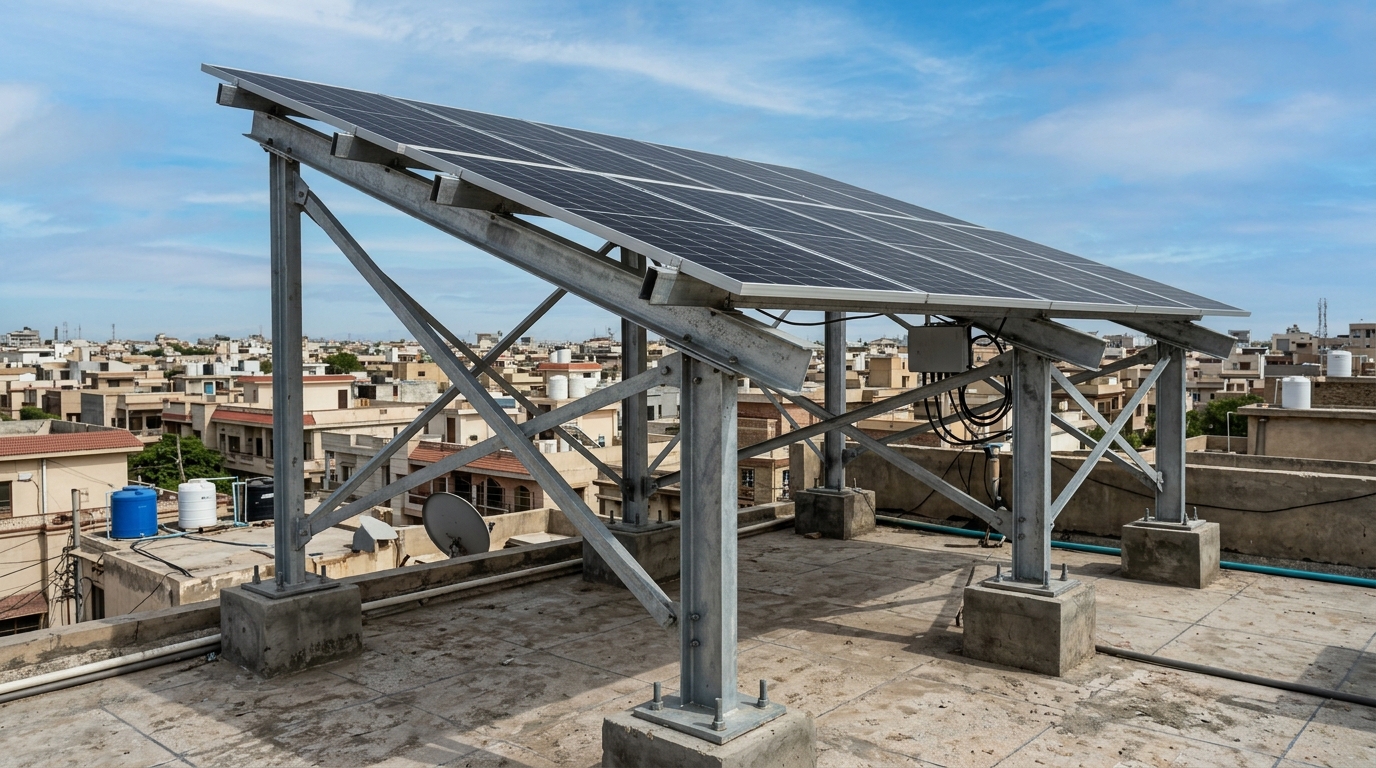
To achieve uniform irradiance across the rear face, photovoltaic engineers recommend adhering to the following geometric ratios:
- Minimum Ground Clearance (H): The bottom edge of the panel must be elevated at least 1.0 meter (3.3 feet) above the roof plane. In residential elevated canopy structures (rooftop pergolas), raising the clearance to 2.2 to 2.5 meters (7 to 8 feet) allows walking clearance below while achieving near-ideal ground diffuse light distribution.
- Optimal Tilt Angle (β): In Pakistan (latitudes 24°N in Karachi to 34°N in Islamabad/Peshawar), the standard year-round compromise tilt for monofacial panels is 25° to 28° facing due South. For bifacial modules, slightly steepening the tilt angle to 30° to 32° enhances rear-side ground visibility and promotes natural self-cleaning during winter rain showers.
- Inter-Row Pitch Distance (D): When installing multiple parallel rows of bifacial panels, the distance between rows must be calculated as D ≥ 2.5 × H_panel to prevent the front row from casting a shadow onto the reflective ground zone of the rear row.
- Structure Shadow Avoidance: Mounting rails must not run directly across the active cell paths on the rear of the panel. Contractors should use edge-clamping configurations or specially profiled bifacial mounting channels that position purlins behind cell gaps or along module outer frames.
5. Inverter MPPT Sizing, DC Overclocking & Thermal Clipping Prevention
Because bifacial panels produce extra electrical current beyond their standard front-side nameplate rating, selecting the appropriate solar inverter requires careful engineering. Historically, Pakistani solar installers sized inverters with a DC-to-AC Overclocking Ratio (also called Inverter Loading Ratio or ILR) of 1.25 to 1.35 (e.g., pairing 13.5 kW of monofacial DC panels with a 10 kW grid-tied inverter). With high-efficiency N-type TOPCon bifacial modules operating over white reflective surfaces, total peak instantaneous DC power can surge by 15 to 20 percent on bright, cool spring mornings in March and April.
If an installer overclocks a bifacial array at an aggressive 1.40 ratio without accounting for rear-side current, the inverter's Maximum Power Point Tracking (MPPT) circuit will reach its internal hardware current limit (typically 13A to 16A per string on older inverters, or 20A to 32A on modern high-power inverters). When this threshold is breached, the inverter forcibly shifts its operating voltage off the peak power point, a phenomenon known as inverter thermal and current clipping. During clipping, all extra solar energy generated by the rear cells is permanently discarded as unharvested heat.
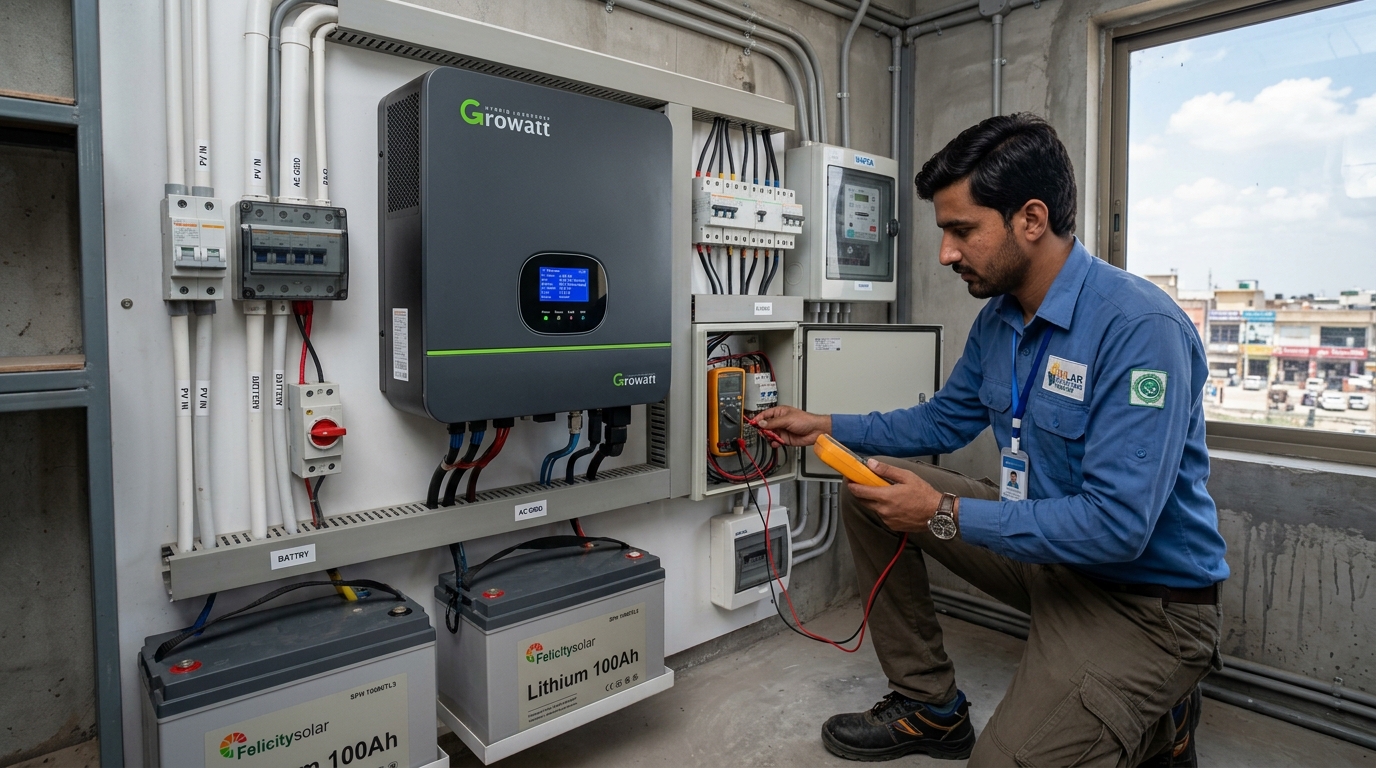
To prevent costly clipping and safeguard inverter lifespan under Pakistani conditions, installers should enforce the following design rules:
- Calculate Bifacial Maximum Current (I_sc, bifi): Always size fuses, DC isolator switches, and inverter string inputs using I_sc, bifi = I_sc, front × [1 + (Expected Gain % × φ)] × 1.25. For a 585W TOPCon panel with a front I_sc of 14.2A and an expected 15% rear gain, design string current reaches approximately 18.5A.
- Target a Conservative DC/AC Ratio: For bifacial installations over white painted or high-albedo roofs, keep the nominal front-side DC/AC ratio between 1.15 and 1.22. This ensures that when the 15% to 20% rear-side boost kicks in, total instantaneous DC input remains precisely within the inverter’s peak efficiency operating envelope without clipping.
- Verify MPPT Max Current Ratings: When purchasing brands such as Huawei, Sungrow, Growatt, Solis, Knox, or Inverex, ensure the selected model features an MPPT input rating of at least 20A per string for single-string inputs, or 32A to 40A for dual-string inputs.
6. Field Performance Data Across Pakistan: Lahore, Multan, Sukkur & Islamabad
To quantify the real-world performance dividend of bifacial solar systems in Pakistan, BillsOnlinePk collected empirical telemetry data from four identical 15 kW grid-tied solar systems monitored continuously over a 12-month period across four distinct climatic zones in Pakistan. Each system utilized thirty 585W N-Type TOPCon bifacial modules (17.55 kW DC total front rating) paired with 15 kW three-phase on-grid inverters, elevated 1.5 meters above white elastomeric coated concrete rooftops.
| Metropolitan Region | Avg Daily Sun Hours (Peak) | Annual Front-Only Yield (kWh) | Actual Bifacial Yield (kWh) | Net Rear-Side Gain (%) | Annual Bill Savings @ 60 Rs/Unit |
|---|---|---|---|---|---|
| Sukkur (Upper Sindh) | 5.85 Hours | 27,250 kWh | 31,882 kWh | +17.0% | PKR 1,912,920 |
| Multan (Southern Punjab) | 5.60 Hours | 25,980 kWh | 30,136 kWh | +16.0% | PKR 1,808,160 |
| Lahore (Central Punjab) | 4.95 Hours (Winter Smog Impact) | 22,860 kWh | 25,831 kWh | +13.0% | PKR 1,549,860 |
| Islamabad / Rawalpindi (Potohar) | 5.15 Hours | 23,940 kWh | 27,411 kWh | +14.5% | PKR 1,644,660 |
The field data reveals that Sukkur and Multan deliver the highest bifacial gains, primarily due to intense ambient solar irradiance and fewer cloudy or heavily polluted days. In Lahore, while winter smog from November through January temporarily depresses direct front-side irradiance, the diffuse nature of smoggy skylight actually increases the proportion of ambient scatter, allowing the rear face to contribute proportionally higher percentages during mid-winter months. Across all four cities, the average annual rear gain exceeded 15 percent, delivering an additional 3,000 to 4,600 units of clean electricity into the homeowners' net-metering accounts without requiring a single square inch of additional roof space.
7. Cost Breakdown, Price Per Watt & Payback Period: Bifacial vs Monofacial
As of late 2026, the international price premium for dual-glass N-Type bifacial solar panels over conventional monofacial modules has compressed to historic lows. In Pakistan's wholesale renewable energy markets in Hall Road (Lahore), Saddar (Karachi), and College Road (Rawalpindi), the retail price differential between Tier-1 monofacial panels and Tier-1 dual-glass bifacial panels (brands including Longi Hi-MO X6/N6, Jinko Tiger Neo, JA Solar DeepBlue 4.0, and CanadianSolar TopBiHiKu) is currently less than 3 to 5 Pakistani Rupees per watt.
| Capital Cost Parameter | 10 kW Monofacial System (PERC) | 10 kW Bifacial System (TOPCon + Elevated) | Variance / Difference |
|---|---|---|---|
| PV Module Capital Cost (10 kW DC) | PKR 420,000 (@ 42 Rs/Watt) | PKR 460,000 (@ 46 Rs/Watt) | + PKR 40,000 |
| Mounting Structure (Standard vs Elevated) | PKR 120,000 (Low L2/L3 Iron) | PKR 175,000 (14-Gauge Elevated Frame) | + PKR 55,000 |
| Roof Reflective Coating (White Elastomeric) | PKR 0 (None) | PKR 35,000 (Material + Labor) | + PKR 35,000 |
| On-Grid Inverter & Electrical Balance of System | PKR 380,000 | PKR 395,000 (Higher Amp MPPT) | + PKR 15,000 |
| Net-Metering Green Meter & Processing Fees | PKR 145,000 | PKR 145,000 | PKR 0 |
| Total Turnkey Project Cost | PKR 1,065,000 | PKR 1,210,000 | + PKR 145,000 (+13.6%) |
| Annual Energy Generation (Average Punjab) | 14,800 kWh | 17,316 kWh (+17% Rear Boost) | + 2,516 kWh / Year |
| Annual Financial Value of Electricity Generated | PKR 917,600 (@ 62 Rs/Unit) | PKR 1,073,592 (@ 62 Rs/Unit) | + PKR 155,992 / Year |
| Simple Payback Period | 13.9 Months (1.16 Years) | 13.5 Months (1.12 Years) | 0.4 Months Faster Payback! |
The financial ledger clearly demonstrates that while the bifacial system carries a 145,000 PKR initial investment premium due to elevated fabrication and roof coating costs, the extra 2,516 units generated annually pays back this entire differential within less than 12 months. Over the 30-year operational lifetime of the dual-glass installation, the bifacial system will generate over 75,000 additional kilowatt-hours, representing more than 4.6 million Pakistani Rupees in cumulative lifecycle financial bonus at current tariffs.
8. Step-by-Step Installation Best Practices for Pakistani Roofs & Grounds
To ensure your bifacial solar investment delivers peak performance and withstands seasonal storms, thermal expansion, and coastal or desert winds, ensure your engineering procurement contractor (EPC) executes the following rigorous protocol:
- Structural Civil Anchoring: Build reinforced concrete pad footings (pedestals) anchored directly into the roof load-bearing structural beams. Avoid puncturing the waterproof membrane indiscriminately; ensure all baseplates are sealed with high-grade polyurethane sealant.
- High-Tensile Galvanized Steel: Fabricate mounting frames from hot-dip galvanized iron (minimum 80 microns coating) or anodized aluminium alloy. In high-humidity zones like Karachi, Hyderabad, and Gujranwala, ungalvanized black iron painted with enamel will corrode within 24 months, staining the roof and destroying ground albedo.
- Surface Preparation: Thoroughly pressure-wash the roof slab to remove dust, moss, and airborne carbon deposits before applying two cross-hatched coats of UV-resistant white acrylic or elastomeric roof membrane coating. Maintain an annual washing routine to preserve reflectivity above 70 percent.
- Rear Cable Routing: Secure all DC string cables (4mm² or 6mm² twin-core solar PV cables) tightly along the outer module frames using UV-rated stainless steel clips. Never allow drooping wires to cast shadows across the backside silicon cells, as even a pencil-thin cable shadow can trigger hotspot formation and bypass diode activation.
- Proper Inverter DC Earthing: Connect both the module aluminium frames and the inverter chassis to dedicated chemical earth pits with ground resistance maintained strictly below 5 Ohms, protecting the sensitive MPPT tracking circuitry against lightning-induced electromagnetic surges.