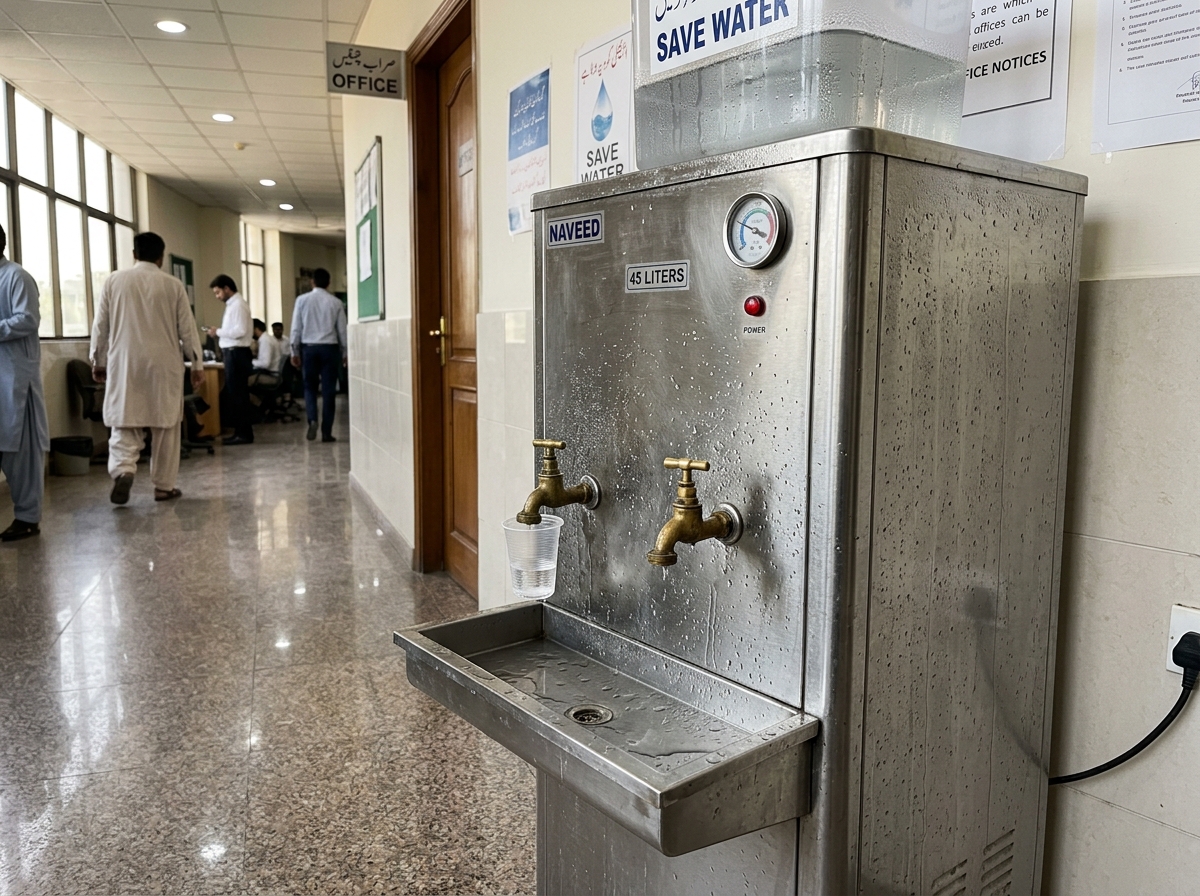
1. Water Chilling & Heating Infrastructure in Pakistani Homes, Offices & Mosques
Across Pakistan, where intense summer temperatures regularly soar above 42°C in major cities like Lahore, Multan, Faisalabad, Hyderabad, and Karachi, accessible chilled drinking water is an absolute physiological necessity. Conversely, during chilly winter mornings, instant access to boiling water for tea, coffee, and medicinal purposes is equally prized. To fulfill these dual demands, two distinct appliance categories dominate the market: heavy-duty Commercial Stainless Steel Storage Water Coolers (ubiquitous in mosques, commercial offices, educational academies, factories, and outdoor public welfare points) and elegant Hot & Cold Bottled Water Dispensers (standard in contemporary Pakistani residential drawing rooms, kitchens, and executive corporate offices).
While consumers pay meticulous attention to the energy efficiency of inverter air conditioners and refrigerators, water cooling and heating appliances are routinely ignored. Left plugged into wall sockets 24 hours a day, 365 days a year, these unassuming machines continuously cycle heavy refrigeration compressors and high-wattage electric immersion heating elements. Under current National Electric Power Regulatory Authority (NEPRA) domestic non-protected tariffs (exceeding 60 PKR per unit) and commercial A-2 tariffs (exceeding 75 PKR per unit with peak-hour surcharges), an unmanaged water dispenser or commercial cooler can quietly add PKR 6,000 to PKR 15,000 to your monthly electricity bill.
In this comprehensive engineering study, BillsOnlinePk provides an exhaustive technical comparison of power consumption, reveals the shocking hidden cost of 24/7 water boiling elements, and details automated energy-saving solutions that preserve water temperature while slashing wasted electricity units.
Shocking Fact: The internal hot water heating tank inside a domestic water dispenser consumes up to five times more electricity than the cooling compressor! Keeping a water dispenser’s red heating switch turned ON overnight when nobody is drinking hot water wastes 2.5 to 3.5 units of electricity every single night.
2. Commercial Stainless Steel Storage Water Cooler (35L to 65L) Engineering & Compressor
Commercial water coolers (manufactured by renowned Pakistani brands such as Super Asia, Singer, Mehran, NasGas, and local Gujranwala metal fabricators) are industrial workhorses designed for high-volume chilled water output. They feature an insulated, food-grade 304 or 316 stainless steel storage tank ranging in capacity from 35 liters to 100 liters, wrapped externally with copper refrigeration tubing.
The core mechanical powertrain consists of:
- Reciprocating Refrigeration Compressor: Typically rated between 1/4 Horsepower (HP) for 35-liter models up to 1/2 HP or 3/4 HP for massive 65L/100L commercial models. Running on R134a or eco-friendly R600a refrigerant, these compressors draw an instantaneous power of 190 Watts to 380 Watts while active.
- Forced-Air Wire-Tube Condenser & Fan: A small shaded-pole electric fan motor (typically drawing 25W to 40W) blows ambient air across the wire-tube condenser coil situated at the bottom or rear of the cooler cabinet to reject extracted heat into the surroundings.
- Mechanical Capillary Thermostat: Regulates water temperature between 6°C and 12°C. In high-traffic public installations (such as roadside charity water filtration plants or school courtyards), warm tap water continuously enters the tank as chilled water is dispensed. This forces the compressor to run continuously for 12 to 16 hours daily during summer heatwaves.
Total Running Power Draw: When active, a standard 45-liter commercial water cooler draws approximately 250 to 320 Watts of continuous electrical power. Because it contains zero electrical heating elements, its energy consumption is dedicated entirely to refrigeration.
3. Domestic Hot & Cold Water Dispenser Power Draw: Chilling vs Heating Elements
A contemporary hot and cold water dispenser (brands including Dawlance, Gree, Haier, Orient, Homage, and Pel) is an intricate dual-thermal appliance. Concealed behind its plastic and tempered glass exterior are two completely separate internal reservoirs:
- Cold Water Chilling Chamber (approx. 3.0 to 4.5 Liters): Chilled by a compact 1/10 HP or 1/8 HP mini-compressor drawing only 85 Watts to 120 Watts when active. When the water reaches approximately 7°C to 10°C, the thermostat cuts off the compressor. In a cool, air-conditioned room with minimal water usage, the compressor runs for only 15 to 20 minutes per hour.
- Hot Water Heating Chamber (approx. 1.0 to 1.5 Liters): To provide instantaneous 90°C to 95°C water for brewing black tea or green tea, the hot tank incorporates a heavy internal or external sheath resistive electric immersion heating element drawing 500 Watts to 650 Watts!
Unlike an electric kettle—which boils water on demand and shuts down automatically—a water dispenser’s hot tank relies on a bi-metallic snap-disc thermostat. The water reaches 92°C, the heater turns off; within 15 minutes, standby thermal radiation through the tank’s thin foam insulation cools the water to 83°C, prompting the 600W heater to turn back on! This relentless cycle repeats 24 hours a day, 7 days a week.
| Appliance Subsystem | Rated Wattage (Watts) | Daily Duty Cycle (% Active) | Daily Units Consumed (kWh) | Monthly Electricity Units (kWh) |
|---|---|---|---|---|
| Water Dispenser Cooling Compressor Only | 90W - 120W | 35% (approx. 8.4 Hours/Day) | 0.85 kWh | 25.5 kWh / Month |
| Water Dispenser Hot Water Element Only | 500W - 650W | 30% (Thermostat Re-heating Cycle) | 4.10 kWh | 123.0 kWh / Month |
| Water Dispenser Combined (Both ON 24/7) | 620W - 770W Peak | Intermittent 24-Hour Cycling | 4.95 kWh | 148.5 kWh / Month! |
| Commercial 45-Liter Water Cooler (Summer) | 260W - 320W | 50% (approx. 12 Hours/Day) | 3.45 kWh | 103.5 kWh / Month |
4. The Hidden Vampire Cost: Keeping Water Constantly Boiling at 90°C 24/7
The calculation in the table above exposes an alarming reality: over 80 percent of a water dispenser’s total monthly electricity bill is generated exclusively by the hot water heating element!
Let us analyze what happens when a family leaves the red "Hot Water" switch ON continuously on the back of their dispenser. During the night (from 11:00 PM to 7:00 AM, an 8-hour stretch where the entire household is asleep and zero water is poured), the 550W heating element cycles ON every 20 minutes to re-boil the unconsumed water against ambient heat loss. Over that 8-hour sleep window alone, the dispenser wastes approximately 1.4 kilowatt-hours of electricity every single night. Over a 30-day billing cycle, this phantom nighttime boiling wastes 42 units of electricity, directly costing the homeowner over PKR 2,520 per month in pure, unadulterated thermal waste!
5. Empirical 24-Hour Energy Measurement Tests: Summer Chilling vs Winter Heating
To provide empirical precision for Pakistani consumers, BillsOnlinePk connected digital plug-in energy power meters to three identical 3-tap bottled water dispensers deployed across different usage environments in Lahore, monitored continuously over a 24-hour cycle:
| Test Scenario & Operating Mode | Compressor Status | Heating Switch Status | Measured 24-Hr Units (kWh) | Monthly Units (30 Days) | Monthly Bill @ 62 Rs/Unit |
|---|---|---|---|---|---|
| Scenario A: Both Switches ON 24/7 (Typical Pakistani Home) | Cold ON (Thermostat 8°C) | Hot ON (Thermostat 92°C) | 5.12 kWh | 153.6 kWh | PKR 9,523 |
| Scenario B: Cold Switch Only ON (Hot Switch Turned OFF) | Cold ON (Thermostat 8°C) | Hot OFF (Element Disabled) | 0.94 kWh | 28.2 kWh | PKR 1,748 |
| Scenario C: Smart Timer Automated (Hot ON only 7AM-10AM & 6PM-9PM) | Cold ON (24/7) | Hot ON (6 Hours Daily Active) | 2.15 kWh | 64.5 kWh | PKR 3,999 |
The data reveals that simply toggling the red hot water switch OFF when hot water is not actively needed reduces the monthly bill from PKR 9,523 down to PKR 1,748—a massive monthly saving of PKR 7,775 (an 81.6% reduction)! If hot water is required for morning breakfast and evening tea, using a smart timer limits heating to peak demand windows, still delivering over PKR 5,500 in monthly net bill savings.
6. Smart Timer Automation: Slashing 40% of Nighttime Standby Electricity Waste
Manually remembering to flip the tiny rocker switch behind a water dispenser multiple times a day is impractical for busy households. The ultimate engineering solution is retrofitting an inexpensive 24-Hour Mechanical Pin Timer (costing PKR 900 to PKR 1,200) or a Smart WiFi Plug (such as Tuya, Sonoff, or Broadlink, costing PKR 1,800 to PKR 2,500):
- Commercial Water Cooler Timer Automation (Offices & Schools): In commercial offices that operate from 9:00 AM to 6:00 PM Monday through Friday, water coolers left plugged in run all weekend and every night, cooling water for an empty building! Programming a 24/7 timer to shut off the cooler from 7:00 PM to 8:00 AM and entirely on weekends cuts monthly commercial electricity consumption by 60 to 70 percent, saving thousands of rupees under expensive commercial A-2 tariffs.
- Residential Hot Water Scheduling: For domestic dispensers with separate power plugs for hot and cold (or using a dedicated timer for the hot circuit), schedule heating exclusively during two prime windows: 6:30 AM to 9:30 AM (Breakfast) and 5:00 PM to 9:00 PM (Evening Tea). The dispenser automatically stays powered down during working hours and overnight sleep hours.
7. Monthly Expense Analysis: Domestic A-1 Tariff vs Commercial A-2 Tariff
Water cooling economics vary profoundly depending on your electrical tariff classification under NEPRA rules:
- Domestic Tariff A-1 (Protected vs Unprotected Slabs): In domestic homes, a water dispenser consuming 150 units monthly can single-handedly destroy a family’s Protected Category Status (keeping total consumption under 200 units). Once pushed over 200 units, the tariff jumps from ~22 PKR/unit to ~48 PKR/unit, inflating the entire household electricity bill by 100 percent!
- Commercial Tariff A-2 (Shops, Clinics, Offices): Commercial connections are billed at a flat base tariff exceeding 62 to 72 PKR per unit plus 18% GST, Fixed Charges per kW of Sanctioned Load, and Time-of-Use peak penalties. In a commercial establishment running two water coolers and a dispenser, water cooling alone accounts for over 450 units monthly, generating a standalone electrical expense exceeding PKR 35,000 to PKR 42,000 per month.
8. Preventative Maintenance: Condenser Coil Cleaning, Thermostats & Sanitation
A poorly maintained water cooler or dispenser consumes significantly more electricity as heat transfer efficiency degrades. Execute this maintenance protocol every quarter:
- Condenser Coil De-Dusting: Unplug the unit. Pull the dispenser or cooler away from the wall and inspect the black wire-tube condenser grid at the back. When coated with airborne dust, oil, and lint, refrigerant cannot reject heat efficiently, forcing the compressor to run 30 to 50 percent longer to achieve cooling. Vacuum or brush the coils clean every three months.
- Wall Clearance Ventilation: Never shove a water cooler or dispenser flush against the wall! Maintain at least 15 centimeters (6 inches) of clearance on all sides to allow convective air circulation across the condenser coils.
- Thermostat Calibration: Setting a water cooler’s thermostat dial to maximum ("Coldest" or Position 7) causes ice to form around the internal copper coils, insulating the water from further cooling and causing the compressor to run indefinitely without shutting off. Set the dial to medium (Position 3 or 4), which maintains a refreshing 8°C to 10°C temperature with optimal compressor rest cycles.
- Tank Descaling: In Pakistani cities with hard municipal water (such as Lahore, Rawalpindi, and Karachi), dissolved calcium and magnesium carbonates deposit thick white limescale on the heating element. A 1mm scale layer acts as thermal insulation, increasing heating element runtimes by 15 percent. Descale the hot water chamber annually using food-grade citric acid or white vinegar solution.