1. Standby Power Economics in Pakistan: Navigating Grid Blackouts & Surging Fuel Prices
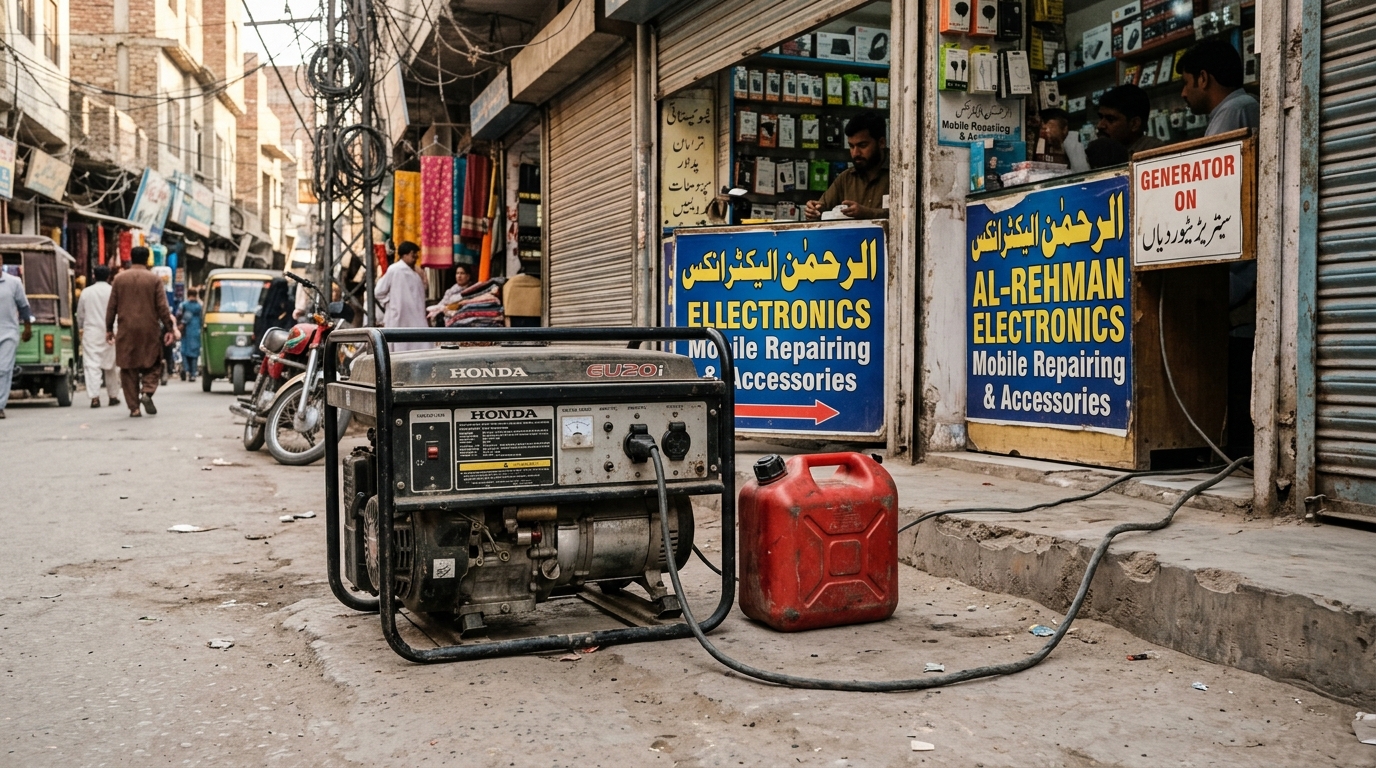
For more than four decades, fossil-fuel-powered internal combustion generators have served as the indispensable backbone of standby power across Pakistan. During prolonged summer load shedding and frequent monsoon feeder tripping, small portable petrol generators hum in residential streets, natural gas and liquefied petroleum gas (LPG) engines power commercial shops, and heavy diesel gensets roar inside textile mills, commercial banks, hospitals, and high-rise towers. In an un-stabilized electrical grid environment, owning an emergency backup generator has long been considered an essential survival requirement for commerce and domestic life.
However, the economic feasibility of operating a generator in Pakistan has collapsed dramatically over the past two years. Soaring international crude oil prices, aggressive currency devaluations, and heavy petroleum development levies have pushed retail fuel prices to historic highs: petrol hovering between 280 and 310 PKR per liter, high-speed diesel (HSD) exceeding 290 to 320 PKR per liter, and commercial LPG cylinders commanding premium rates. At these crushing fuel price points, running a generator is no longer merely expensive—it is an economic catastrophe.
Yet, astonishingly, the vast majority of Pakistani business owners, hospital administrators, and homeowners have never calculated their true cost per electricity unit (kWh) generated. They know they spend PKR 50,000 or PKR 200,000 monthly on fuel cans, but they do not realize they are generating electricity at an eye-watering rate of PKR 90 to over PKR 145 per unit! In this rigorous engineering analysis, BillsOnlinePk demystifies generator fuel thermodynamics, provides mathematical cost calculators across petrol, diesel, and gas, and presents a direct economic comparison against the WAPDA grid and solar lithium storage.
Shocking Economic Fact: Generating electricity from a standard 3 kW portable petrol generator in Pakistan currently costs approximately PKR 115 to PKR 135 per kilowatt-hour (unit)—more than DOUBLE the highest peak-rate tariff on the WAPDA grid, and over FIFTEEN TIMES the levelized cost of rooftop solar power!
2. The Thermodynamic Physics of Internal Combustion Generators: Specific Fuel Consumption
To calculate how much fuel an engine burns to generate electrical power, mechanical engineers utilize the metric known as Brake Specific Fuel Consumption (BSFC), which measures the mass of fuel consumed per unit of mechanical energy produced. When converted into electrical output at the alternator terminals, this is expressed as Specific Fuel Consumption per kWh ($SFC$):
$$ ext{Hourly Fuel Burn (Liters/Hour)} = ext{Electrical Load (kW)} imes SFC ( ext{Liters/kWh})$$
Crucially, an internal combustion engine’s thermodynamic efficiency is not linear. Small single-cylinder carbureted petrol engines operate at dismal thermal efficiencies of only 18% to 24% (meaning more than 75% of the energy in every liter of petrol is wasted as engine heat and exhaust noise!). Heavy multi-cylinder turbocharged diesel engines achieve higher thermal efficiencies of 35% to 42%.
Furthermore, running a generator at partial load (e.g., running a 10 kVA generator with only a 2 kW load) causes specific fuel consumption to spike dramatically. The engine still burns significant fuel just to overcome internal mechanical friction, spin the heavy flywheel, and maintain a constant 3,000 RPM (for 2-pole alternators) or 1,500 RPM (for 4-pole alternators) to generate 50 Hertz AC frequency!
3. Small Petrol Generators (1 kVA to 5 kVA): Hourly Fuel Burn Rates & Load Efficiency
Portable petrol generators (brands like Honda, Yamaha, Hyundai, Firman, Jasco, and Crown) are the standard backup choice for small shops, medical clinics, and middle-class homes. Operating at high speed (3,000 RPM), their fuel consumption profiles follow predictable engineering curves:
| Generator Rated Capacity | Continuous Electrical Load (kW) | Typical Appliances Powered | Hourly Petrol Burn (Liters/Hr) | Cost Per Hour (@ 290 Rs/Liter) | Cost Per Unit (kWh) Produced |
|---|---|---|---|---|---|
| 1.5 kVA (Portable) | 1.0 kW (100% Load) | 3 Ceiling Fans + 6 LED Bulbs + TV | 0.85 Liters | PKR 246.50 | PKR 246.50 / Unit! |
| 3.0 kVA (Standard Home) | 2.0 kW (66% Load) | Fans + Refrigerator + Water Pump | 1.40 Liters | PKR 406.00 | PKR 203.00 / Unit! |
| 3.0 kVA (Standard Home) | 1.0 kW (33% Light Load) | Only Fans and Lights (Under-loaded) | 1.05 Liters | PKR 304.50 | PKR 304.50 / Unit! |
| 5.0 kVA (Heavy Home) | 3.5 kW (70% Load) | One 1.5-Ton Inverter AC + Fans + Fridge | 2.25 Liters | PKR 652.50 | PKR 186.42 / Unit! |
Notice the catastrophic penalty of running a generator under-loaded: running a 3 kVA generator with only 1.0 kW of light appliances causes the effective cost per electricity unit to skyrocket past PKR 304 per unit!
4. Commercial Gas & LPG Conversions: Fuel Consumption vs Engine Lifespan & Valve Recession
To escape crushing petrol bills, hundreds of thousands of Pakistani consumers convert small petrol generators to run on Natural Gas (SNGPL line gas) or Liquefied Petroleum Gas (LPG commercial cylinders) using aftermarket zero-pressure dual-fuel carburetors costing PKR 2,500 to PKR 4,000:
- The Economic Attraction: When low-pressure natural gas is available in the pipeline, fuel cost drops by 60 to 75 percent compared to petrol. Even with commercial LPG cylinders (costing approx. 280 to 320 PKR per kg), generating electricity costs approximately PKR 75 to PKR 95 per unit—significantly cheaper than petrol, though still higher than grid tariffs.
- The Severe Mechanical Penalty: Petrol fuel contains microscopic liquid lubricants that cool and cushion engine intake and exhaust valves. Dry gaseous fuels (LPG and CNG) burn with higher combustion chamber temperatures and zero lubricating properties. Over 200 to 400 hours of continuous operation on LPG:
- The cylinder head experiences severe Valve Seat Recession: exhaust valves sink deeply into the aluminum head, destroying engine compression.
- Engine power derates by 15% to 20% (a 3 kVA petrol generator produces only 2.4 kVA on gas).
- Spark plugs foul with white ceramic ash deposits, requiring frequent re-gapping.
5. Industrial Diesel Generators (15 kVA to 250 kVA): Prime vs Standby Power Fuel Curves
In commercial offices, factories, hospitals, and apartment complexes, High-Speed Diesel Generators (HSD Gensets) powered by renowned industrial engines (such as Perkins, Cummins, Caterpillar, Lister Petter, and Baudouin) provide high-capacity power at 1,500 RPM:

| Genset Prime Rating (kVA / kW) | 50% Load Fuel Burn (L/Hr) | 75% Load Fuel Burn (L/Hr) | 100% Load Fuel Burn (L/Hr) | Effective Cost Per Unit (@ 300 Rs/L Diesel at 75% Load) |
|---|---|---|---|---|
| 15 kVA / 12 kW (Bank / Small Clinic) | 2.1 Liters/Hr | 2.9 Liters/Hr | 3.8 Liters/Hr | PKR 96.66 / Unit |
| 30 kVA / 24 kW (Plaza / Department Store) | 3.9 Liters/Hr | 5.4 Liters/Hr | 7.2 Liters/Hr | PKR 90.00 / Unit |
| 60 kVA / 48 kW (Medium Factory / Hospital) | 7.6 Liters/Hr | 10.6 Liters/Hr | 14.1 Liters/Hr | PKR 88.33 / Unit |
| 100 kVA / 80 kW (Commercial Tower / Mill) | 12.5 Liters/Hr | 17.8 Liters/Hr | 23.5 Liters/Hr | PKR 89.00 / Unit |
Across all capacity classes, an industrial diesel generator operating at optimal 75% prime loading burns approximately 0.28 to 0.32 liters of high-speed diesel per kilowatt-hour of electricity produced. At current diesel prices of 300 PKR per liter, pure fuel cost sits at PKR 88 to PKR 97 per unit—completely excluding lubricating oil changes, engine overhaul reserves, and operator wages!
6. Mathematical Formula: Computing Exact Cost Per Electricity Unit (kWh) in Pakistani Rupees
To calculate your true operational cost per unit on any generator, use this master accounting equation:
$$ ext{True Cost Per Unit (PKR/kWh)} = rac{( ext{Liters Burned} imes ext{Fuel Price/Liter}) + ext{Maintenance Cost/Hour}}{ ext{Actual Electrical Load (kW)} imes ext{Runtime (Hours)}}$$
Authentic Case Study: A dental clinic in Multan operates a 5 kVA petrol generator during 4 hours of daily load shedding, running a constant 2.5 kW load (dental chair compressor, lighting, one 1.5-ton AC). The generator burns 1.8 liters of petrol per hour:
- Daily Fuel Consumption: 1.8 L × 4 Hours = 7.2 Liters.
- Daily Fuel Cost: 7.2 L × 290 PKR = PKR 2,088.00 per day.
- Daily Units Generated: 2.5 kW × 4 Hours = 10.0 kWh (Units).
- True Fuel Cost Per Unit: PKR 2,088 / 10 Units = PKR 208.80 per unit!
- Monthly Financial Expense (26 Days): PKR 54,288.00 spent every month on petrol cans!
7. Head-to-Head Comparison: Generator vs WAPDA Grid vs Solar Photovoltaic + Lithium Storage
The table below provides a shocking comparison of the four primary electricity sources available in Pakistan in 2026:

| Power Generation Source | Cost Per Unit (PKR / kWh) | Noise & Acoustic Pollution | Environmental Emissions | Operational Maintenance |
|---|---|---|---|---|
| Portable Petrol Generator (1-5 kVA) | PKR 185 - PKR 250 / Unit | Deafening (85 - 95 dB); highly disruptive to neighbors. | Toxic exhaust fumes, carbon monoxide, heavy carbon footprint. | Weekly oil changes, fouled spark plugs, fuel line cleaning. |
| Industrial Diesel Generator (15-100 kVA) | PKR 88 - PKR 97 / Unit | High (75 - 85 dB with acoustic canopy). | Black soot particulate matter (PM2.5), sulfur oxides. | Mobil oil filters, air filters, radiator coolant checks. |
| WAPDA Utility Grid (Non-Protected) | PKR 58 - PKR 65 / Unit | Silent at point of consumption. | Centralized utility generation emissions. | Zero appliance maintenance; subject to unannounced blackouts. |
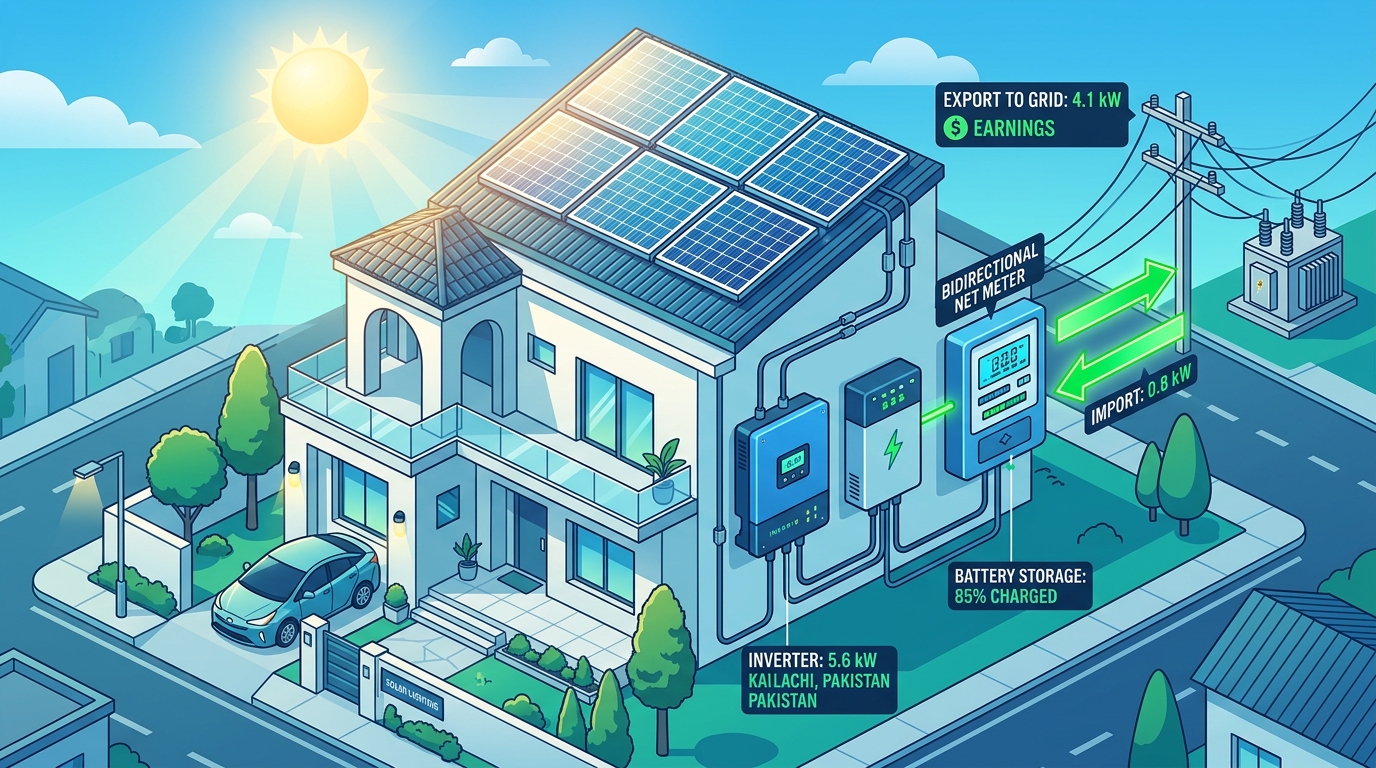
| Solar PV + LiFePO4 Lithium Battery Storage | PKR 7.50 - PKR 9.20 / Unit (Levelized) | 100% Inaudible & Silent | 100% Clean Zero-Emission Energy | Occasional panel washing with clean water; 15-year battery life! |
The Inevitable Conclusion: Generating electricity on a solar hybrid system paired with lithium batteries is TEN TO TWENTY TIMES CHEAPER than running a petrol generator! The PKR 54,000 monthly fuel expense in the case study above would completely fund the purchase and installation of a 5 kW solar system with a 5 kWh lithium battery in less than 14 months, providing 15 years of silent, free emergency power.
8. Preventative Engine Maintenance: Synthetic Oil Intervals, Spark Plugs & Fuel Filters
If you must maintain a standby generator for emergency life-support or critical commercial duties, execute this maintenance protocol to minimize fuel waste:
- Enforce 50-Hour Oil Changes: Small air-cooled petrol engines hold less than 1.0 liter of engine oil and have no oil filter. Thermal breakdown occurs rapidly. Change oil every 50 operational hours using high-grade 10W-40 or 20W-50 motorcycle/generator 4T oil. Degraded oil increases internal engine friction, burning 10% more fuel.
- Spark Plug Cleaning & Gapping: Inspect spark plugs every 100 hours. Set electrode gap strictly to 0.7mm to 0.8mm. A weak, yellow spark leads to incomplete combustion, dumping unburned fuel out the muffler.
- Drain Carburetor Float Bowl Before Storage: Never leave stale petrol in a carburetor for months of standby inactivity. Pakistani petrol oxidizes into thick, sticky green varnish within 30 days, clogging microscopic idle jets and causing the engine to hunt, surge, and burn excessive fuel when restarted. Turn off the fuel petcock and let the engine run until it starves of fuel before storage.