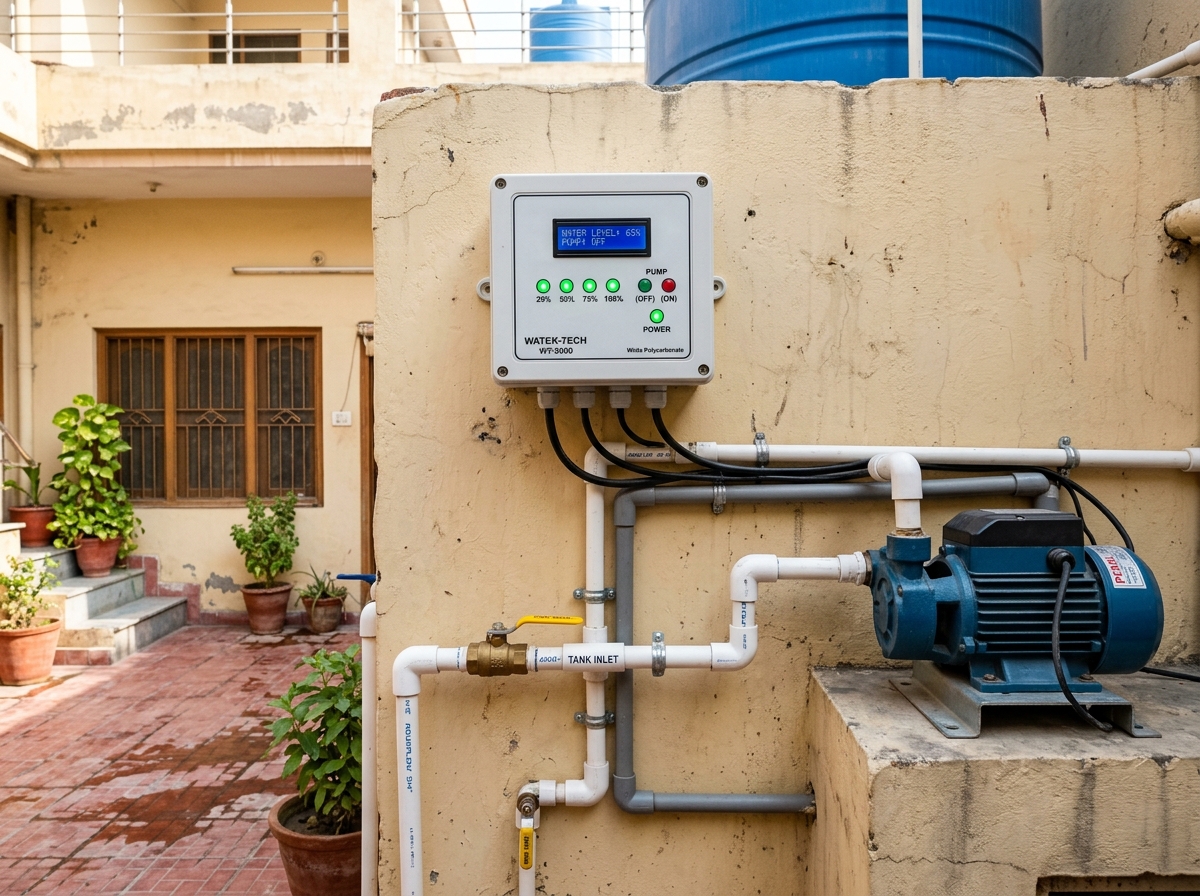
1. The Water Overflow & Motor Burnout Crisis Across Pakistani Households
In almost every residential neighborhood across urban and semi-urban Pakistan—whether in Lahore, Karachi, Rawalpindi, Multan, Gujranwala, or Peshawar—a familiar and distressing scene plays out daily. A household turns on their 1.0 Horsepower (HP) donkey pump or 1.5 HP centrifugal monoblock turbine pump to fill the rooftop concrete or plastic water storage tank. The homeowner becomes occupied with domestic chores, walks away, or leaves for office, completely forgetting that the motor is running.
Thirty minutes later, the rooftop tank reaches maximum capacity and begins cascading hundreds of gallons of clean drinking water down the parapet walls, flooding the roof slab, damaging external wall paint, creating structural seepage, and turning the street below into a muddy quagmire. Worse still, by the time someone notices the deafening waterfall and rushes to turn off the switch, the high-draw electric motor has run needlessly for 45 to 60 extra minutes. Alternatively, when municipal tap water supply from WASA (Water and Sanitation Agency) or KWSB (Karachi Water and Sewerage Board) unexpectedly runs dry mid-cycle, the pump continues spinning dry without water lubrication, causing the copper motor windings to overheat and burn out within 20 minutes, saddling the homeowner with an expensive PKR 5,000 to PKR 12,000 rewinding bill.
Under current NEPRA electricity tariff slabs where unit rates exceed 60 PKR per kWh, water pump mismanagement is a major hidden driver of inflated electricity bills. Installing a solid-state Automatic Water Level Controller with Dry-Run Protection permanently eliminates human forgetfulness, prevents structural water damage, safeguards pump motors, and reliably saves 30 to 60 units of electricity every single month. In this practical technical guide, BillsOnlinePk explains how water level automation works, provides full wiring schematics, and calculates the exact economic payback.
Economic Fact: A 1.5 HP water pump running for just 45 minutes of accidental tank overflow every day wastes approximately 34 kilowatt-hours (units) of electricity every month. At 62 Rs per unit, that overflowing water literally flushes over PKR 2,100 down the drain every single month in wasted electricity alone!
2. Operating Power of Residential Donkey Pumps (1 HP) & Monoblock Turbines (1.5 HP)
To quantify electrical savings, we must examine the physical power consumption of water extraction pumps installed in Pakistani homes:
- 1.0 HP Reciprocating "Donkey" Pump (Piston Pump): The traditional favorite in older Pakistani homes due to its ability to pull water against low municipal suction pressure. While nominally rated at 1.0 Horsepower (746 Watts of mechanical work), low-efficiency local single-phase induction motors operate at a poor power factor (0.75 to 0.80). The actual electrical power draw measured at the meter ranges between 950 Watts and 1,150 Watts (approx. 1.05 kW).
- 1.5 HP Centrifugal Monoblock / Jet Pump: Commonly installed in 10-Marla and 1-Kanal houses to lift water rapidly from underground water storage sumps (Hauz) to three-story rooftop tanks. Operating power draw ranges between 1,400 Watts and 1,700 Watts (approx. 1.55 kW).
- 2.0 HP Deep-Well Submersible Borehole Pump: Found in areas with deep water tables (such as Quetta, Rawalpindi/Islamabad, and rural Punjab). Power draw hovers between 1,900 Watts and 2,400 Watts (approx. 2.15 kW).
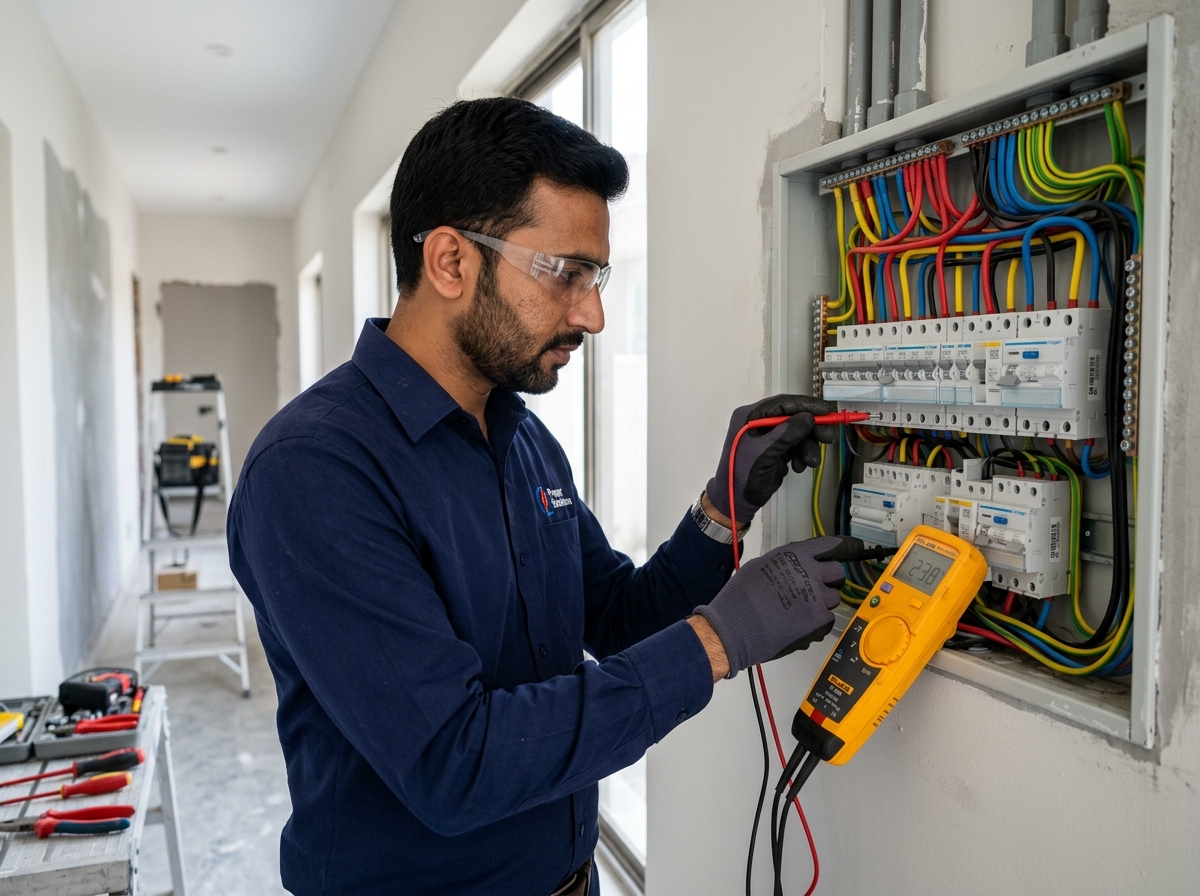
Because induction motor starting currents surge to 4 to 6 times the normal running current (inrush current of 25A to 40A for 2 seconds), cycling a pump multiple times throughout the day due to manual guessing imposes heavy thermal stress on the motor windings and trips sensitive domestic circuit breakers.
3. Operating Principles: Float Switches vs Stainless Steel Conductive Probes
Pakistani homeowners have access to two distinct technological categories of water level automation:
| Feature & Specification | Mechanical / Magnetic Float Switch | Solid-State Conductive Stainless Steel Probes |
|---|---|---|
| Sensing Technology | Hollow plastic floating capsule containing a rolling steel ball and microswitch. | Low-voltage AC electrical conductivity sensed between non-corrosive stainless steel electrodes (SS-304/316). |
| Operating Voltage in Tank | Carries full 230V AC mains voltage inside floating cable (Severe shock risk if wire frays!). | Ultra-safe 5V to 12V low-frequency AC signal (Zero electric shock risk to tank water). |
| Durability & Reliability | Mechanical hinges jam with algae or get tangled in water turbulence within 12 to 18 months. | Zero moving mechanical parts; operates reliably for 5 to 8+ years without failure. |
| Multi-Level Sensing | Binary sensing only (ON / OFF at fixed cord length). | Multi-level precision: High level, Low level, and Ground reference level. |
| Market Hardware Cost | PKR 1,200 - 1,800 per float switch | PKR 3,500 - 6,500 for complete digital controller kit with probes |
Engineering Recommendation: Never install 230V mechanical float switches directly inside residential drinking water tanks! If the floating PVC cable deteriorates under intense Pakistani rooftop UV sunlight (reaching 48°C), 230 Volts can electrify the entire household water supply. Always choose a Microcontroller-Based Conductive Controller that passes an intrinsically safe, galvanic-isolated 5V to 12V low-frequency AC sensing current through stainless steel probes.
4. Dry-Run Protection: Preventing Motor Winding Burnout When Municipal Supply Fails
In Pakistan, municipal water supply is notoriously erratic. Underground water lines suffer from sudden pressure drops, air-locking, and scheduled WASA load shedding. When an automated controller turns on a pump but no water enters the suction pipe:
- The Catastrophic Failure Mode: Inside the pump head, water acts as both a coolant and a hydrodynamic lubricant for the mechanical rubber/ceramic shaft seal and brass impeller. Running dry for more than 10 to 15 minutes causes friction temperatures to surpass 150°C. The mechanical seal melts, boiling water steam leaks into the motor stator housing, and the electrical winding insulation breaks down, causing an immediate phase-to-ground short circuit that burns the motor.
- How Digital Dry-Run Protection Operates: Modern digital controllers incorporate an In-Line Flow Sensor or a Submersible Suction Sump Probe. If the controller starts the pump but the sensor detects zero water flow for 90 continuous seconds, the microcontroller immediately disconnects power to the motor, illuminates a bright red "DRY RUN" warning LED, and initiates a programmed 30-minute to 60-minute cooling wait timer before attempting a single safe retry. This single protective algorithm saves homeowners thousands of rupees in recurring motor rewinding costs!
5. Complete Wiring Diagram: Connecting Controller with Heavy-Duty Magnetic Contactor
The single most common mistake committed by local Pakistani electricians when installing automatic water level controllers is wiring the high-amp motor current directly through the controller’s tiny internal relay.
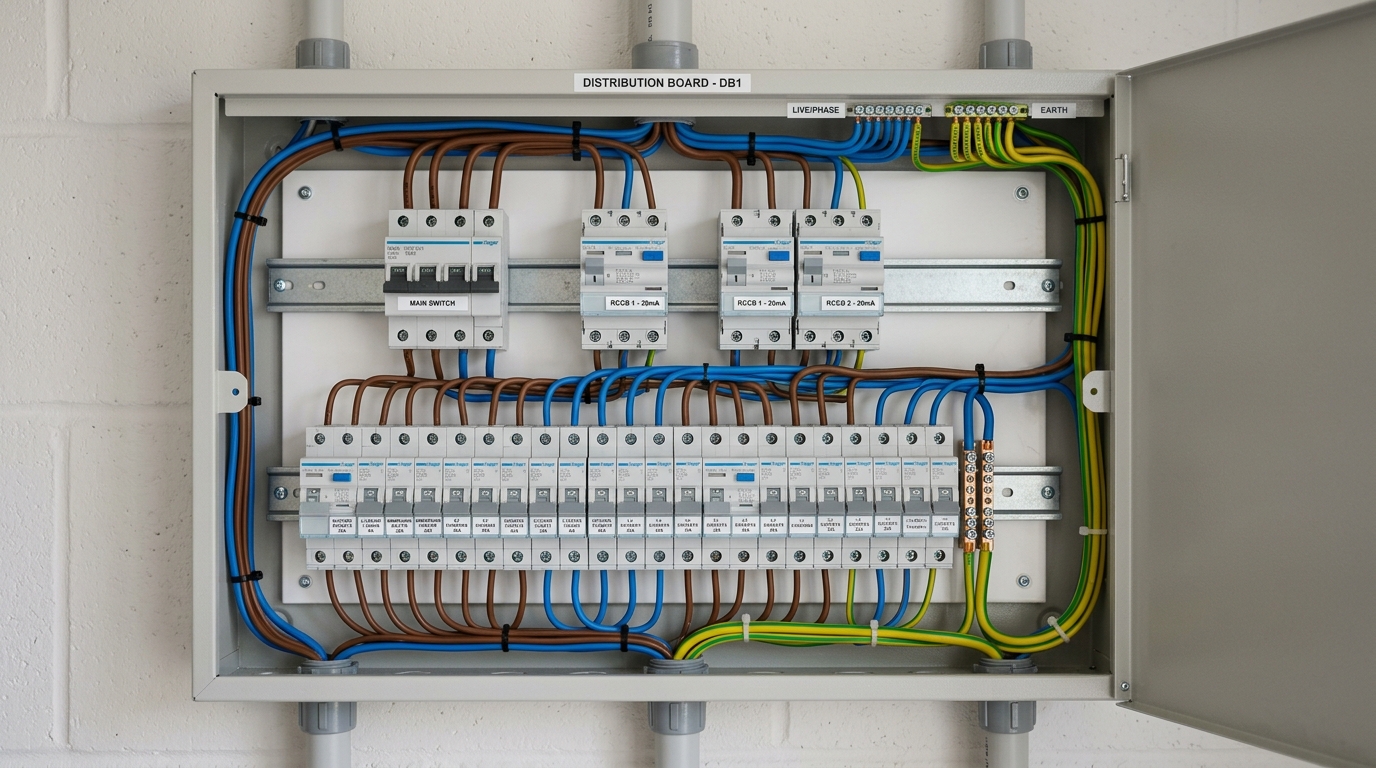
A standard 1.5 HP motor draws 7 Amperes running current, but its inductive starting surge hits 25 to 35 Amperes. The miniature 10A PCB relay inside a commercial water controller will weld its silver contact points together within two to three weeks of operation, causing the pump to run non-stop and flood the house! To ensure permanent, industrial-grade reliability, always install an external AC Magnetic Contactor (25A to 32A rated, 230V AC coil):
- Mains Power Feeder: Route 230V AC Phase and Neutral from a dedicated 16A Miniature Circuit Breaker (MCB) in the distribution board to the main input terminals (L1 and L2) of the Magnetic Contactor.
- Motor Load Terminals: Connect the pump motor’s live and neutral wires directly to the heavy-duty load output terminals (T1 and T2) of the Magnetic Contactor.
- Controller Logic Loop: Power the Automatic Water Level Controller from a separate 2A control fuse. Route the controller’s internal voltage-free relay output directly to the Contactor Coil Terminals (A1 and A2).
- Manual Bypass Switch: Wire a 3-position rotary selector switch (Auto / OFF / Manual) in parallel with the contactor coil. This guarantees that if the electronic controller ever requires servicing, you can switch the pump to "Manual" mode with a single twist of your wrist.
6. Mathematical Formula: Calculating Monthly Unit Savings by Eliminating Tank Overflow
Let us compute the exact return on investment (ROI) for an average Pakistani household in Rawalpindi with a 1.5 HP monoblock pump (1,500 Watts power draw) that overflows for an average of 40 minutes per day due to manual operation:
- Daily Wasted Runtime: 40 Minutes = 0.67 Hours per day.
- Daily Wasted Electricity:
$$ ext{Daily kWh} = 1.5 ext{ kW} imes 0.67 ext{ Hours} = mathbf{1.005 ext{ kWh (Units) wasted per day!}}$$ - Monthly Wasted Units (30 Days):
$$ ext{Monthly kWh} = 1.005 imes 30 = mathbf{30.15 ext{ Units wasted per month!}}$$ - Financial Waste at 2026 Tariffs:
Under typical non-protected domestic billing slabs averaging 62 PKR per unit:
$$ ext{Monthly Financial Loss} = 30.15 imes 62 = mathbf{PKR 1,869.30 ext{ wasted every month!}}$$ - Capital Payback Period: A premium digital water level controller with stainless steel probes and a 25A magnetic contactor costs approximately PKR 5,500 to PKR 6,500 fully installed.
$$ ext{Payback Period} = rac{ ext{PKR } 6,000}{ ext{PKR } 1,869 / ext{month}} = mathbf{3.2 ext{ Months!}}$$
Within just 95 to 100 days, the controller completely pays for itself purely through recovered electricity savings, completely disregarding the invaluable benefits of eliminated roof seepage, saved groundwater, and zero motor burnouts!
7. Troubleshooting Common Sensor Faults: Hard Water Scale, Rust & Solder Corrosion
While electronic controllers are highly reliable, sensor probes suspended inside water tanks operate in a harsh, humid environment. When an automated system malfunctions, it is almost always caused by probe degradation:

- Hard Water Limescale Encrustation: In areas with high Total Dissolved Solids (TDS > 800 ppm), calcium and carbonate minerals deposit a thick, chalky white crust over the metal probes. Because dry limescale is an electrical insulator, the controller fails to detect that water has touched the upper probe, causing the tank to overflow! Remedy: Once every 6 to 12 months, pull the probe cluster from the tank and clean the metal tips with steel wool or dip them in diluted white vinegar for 10 minutes.
- Soldered Wire Joint Corrosion: Novice electricians often solder copper wire directly to stainless steel probes and submerge the bare solder joint in water. Electrolytic action between copper, tin, and stainless steel dissolves the joint within four months. Remedy: Always use marine-grade waterproof heat-shrink tubing filled with hot-melt adhesive over the cable connection, ensuring only the bottom 1 inch of bare stainless steel touches water.
- Algae and Slime Buildup: In transparent or white plastic water tanks exposed to sunlight, green algae blooms cover the probes, creating a conductive bridge between probes even when the tank is empty. Paint the outside of translucent tanks with opaque paint or install UV-stabilized black multi-layer tanks.
8. Dual-Tank Automation: Underground Sump to Overhead Rooftop Tank Synchronization
In most Pakistani urban homes, water architecture is divided into two distinct vessels: an Underground Sump (Zameen-dost Hauz) that collects municipal supply, and an Overhead Rooftop Tank (Chatt ki Tanki) that gravity-feeds domestic plumbing. Advanced controllers provide seamless dual-tank automation using five coordinated probes:
- Probes in Underground Sump:
- Common / Ground Reference Probe: Anchored at the bottom of the sump.
- Sump Low / Dry-Run Probe: Positioned 6 inches above the pump suction foot-valve. If water in the underground sump falls below this level, the pump is instantly locked out to prevent sucking air and sediment.
- Probes in Overhead Rooftop Tank:
- Tank Low Level Probe: Positioned at 25% to 30% tank depth. When water drops below this point, the controller queries the underground sump; if water is present, the pump starts automatically.
- Tank High Level Probe: Positioned 3 inches below the overflow pipe. The second water touches this probe, the pump shuts down instantly with zero overflow.